


Westall Richardson Ltd
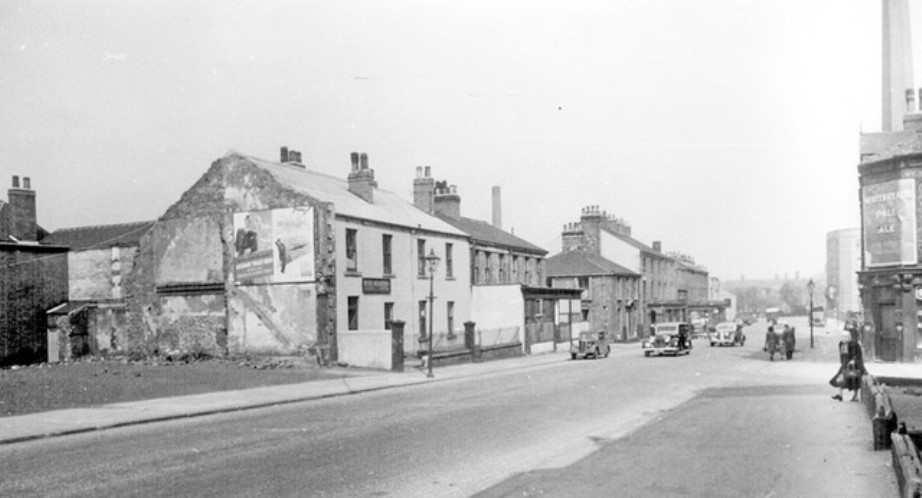
Cavendish Works, Brook Hill, 1948. Picture Sheffield (y01266), Photographer C.H. Lea


The Westall name had various permutations – Waistell, Whestel, Weston, Western, Westale – in Sheffield registers and directories. This family can be traced to Waistell Richardson (bapt. 1781-?), who married Ann Steel. He was a stay maker in Paradise Square and later worked as a grinder. Waistell and Ann had at least two daughters (Hannah and Phebe) and two sons: Westall Richardson (1815-1897) and William Richardson (1818-1892). Westall became a table knife manufacturer and in 1841 was listed at Clarence Street. Besides his involvement in cutlery, he was variously described as a furniture dealer, agent, broker, and gentleman. He died at his home, Mulgrave House, Glossop Road on 4 October 1897, aged 82. In the previous year, he had been hospitalised after falling down the steps at Cutlers’ Hall (Sheffield Daily Telegraph, 20 November 1896). He was buried at Fulwood, leaving £7,165.
His brother, William (who was born at Salford, Manchester), also became a table knife manufacturer. He was first listed at Monmouth Street in 1849, though a founding date of 1839 was later claimed for the business. In 1854, a table knife manufactory – Cavendish Works, Broom Spring Lane – fell vacant (Sheffield Independent, 11 March 1854). William occupied the premises. By 1860, William’s address was Cavendish Works, 60 Broomhall Street, which had a main entrance abutting Broomhall and Fitzwilliam Streets. The factory seems to have been a typical 2 to 3 storey collection of workshops and grinding troughs, with a steam engine large enough to be a smoke nuisance. By 1861, William employed ten men, four boys, and a woman. Besides table knives, William also made pocket knives for the American market (Sheffield Daily Telegraph, 14 January 1869).
By 1871, William lived at Brierley Cottage, Gleadless. His sons were Westall (1843-1917) and Benjamin (1860-?), who also became cutlery manufacturers. Westall joined his father and as the eldest son eventually took over the business. He was apparently joined for a time by Benjamin, who registered the mark ‘LANCET TO CUT’. Benjamin later worked as a spring knife cutler on his own account. In 1875, Cavendish Works was ‘rattened’, when eight wheel bands were cut – allegedly by a disgruntled employee (Sheffield Daily Telegraph, 4 September 1875). It was said that a hundred workers were affected, which gives a clue to the tenement character of the factory, which housed several different trades and craft workers. In 1881, Westall told the Census that he employed a dozen men, two boys, and a woman.
By October 1890, Cavendish Works, Cavendish Street; the premises at Broomhall Street; and those at Fitzwilliam/Broomhall Street were offered to let. The advertisements provide a good snapshot of this agglomeration of industrial buildings and residences (Sheffield Daily Telegraph, 4 July 1891). Westall had moved to New Cavendish Works at 218/220 Brook Hill. Here, too, Westall seems to have gradually taken over a block of workshops fronting Brook Hill, which also extended down one side of Sarah Street. A photograph of the gaslit street (PictureSheffield: s16789) shows the two-storey frontage of 216 Brook Hill, with Westall Richardson’s name above the classical doorway. It looked more like a residential property than a factory. His father, William, had retired by 1891 and was living in Spooner Road. He died there on 20 March 1892, aged 73, and was buried at Fulwood. He left £2,098.
At Brook Hill, Westall continued as a manufacturer of pen, pocket, and table knives, and hand-forged butchers’ knives. He was a Methodist, but neither his personal life nor his business activities were reported much in the press. He was once fined for trade mark fraud, when he stamped some of his table knives as ‘London’ made (Sheffield Independent, 22 April 1892). Westall bought a large stone house at 78 Ivy Park Road at Ranmoor. It was situated in one of the more exclusive residential suburbs in the city, where Westall rubbed shoulders with other wealthy cutlery manufacturers, such as Sidney Nowill. He died on 25 November 1917, aged 74, and was buried in Crookes Cemetery. He left £9,927. Westall’s son – another Westall (1882-1957) – had been manager at the firm, but was serving in the War. Westall’s eldest daughter, Minnie Jane Richardson (1873-1849), took over the management, until her brother returned.
In 1929, a private limited company – Westall Richardson Ltd – was registered at Cavendish Works, Brookhill. The initial capital was £8,000 in £1 shares. Westall Richardson was permanent governing director, with 4,000 shares, and Minnie was the secretary (Sheffield Daily Independent, 12 February 1929). The firm became a specialist in stainless table cutlery, marked ‘LESTAIN’. But it still manufactured hand-forged provision and butchers’ knives and depended on the tried and trusted methods. A trade journal noted that in Brook Hill, not far from the University:
stands a double-fronted house. A stranger … would find little about this house to distinguish it from its neighbours; only a signboard and the appearance of its windows signify that it had ceased to be a family home and has been turned to commercial use … Westall Richardson Ltd know that the best work can only be produced by hand; so, although they supply a certain amount of machine-made goods, most of their work is done by craftsmen, and the processes which first gained their cutlery its high reputation are still in use in modernised form. The grinders sit jockey-wise over their stones, and 'humour' the blade as no machine could (Ironmonger, 16 June 1934).
On the eve of the Second World War, Minnie, a spinster, was still ‘Director Secretary of Private Ltd Company’, living at 78 Ivy Park Road, with her unmarried sisters Ada and Bertha (Register of England & Wales, 1939). She died on 20 February 1949 at The Retreat, a mental institution at York. She left £10,729. An important addition to the directorate before the War was Richard Cecil Vernon Ellis (1893-1979), who had been born in New Zealand and whose British father had been a banking clerk with The British Xylonite Co in London.
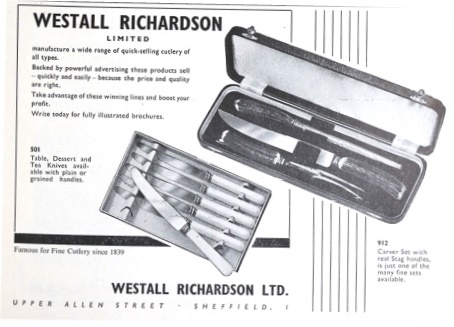
After the War, Westall Richardson Ltd continued to manufacture and advertise a wide range of table cutlery, kitchen knives, and butchers’ and cooks’ knives. The trade mark was ‘PEEREDGE’. The firm remained in family hands until the start of the 1950s, when Westall retired. He lived at Canterbury Avenue, Fulwood, and died on 21 June 1957, aged 75. He left £26,614. Richard C. V. Ellis also appears to have retired at about this time. He died on 28 August 1979, leaving £52,088. According to John Price (of Arthur Price), the firm’s reputation owed much to Harry Gregory – a cutlery maker, engineer, and manager, who became ‘something of a legend’ at the firm (Price, 19971). By the end of the 1950s, Westall Richardson Ltd was owned by American interests and had moved to Regent Cutlery Works, Upper Allen Street. It later became Richardson Sheffield Ltd.
1. Price, John, The Cutlers Tale (Lichfield, 1997)