


Padley & Price Ltd
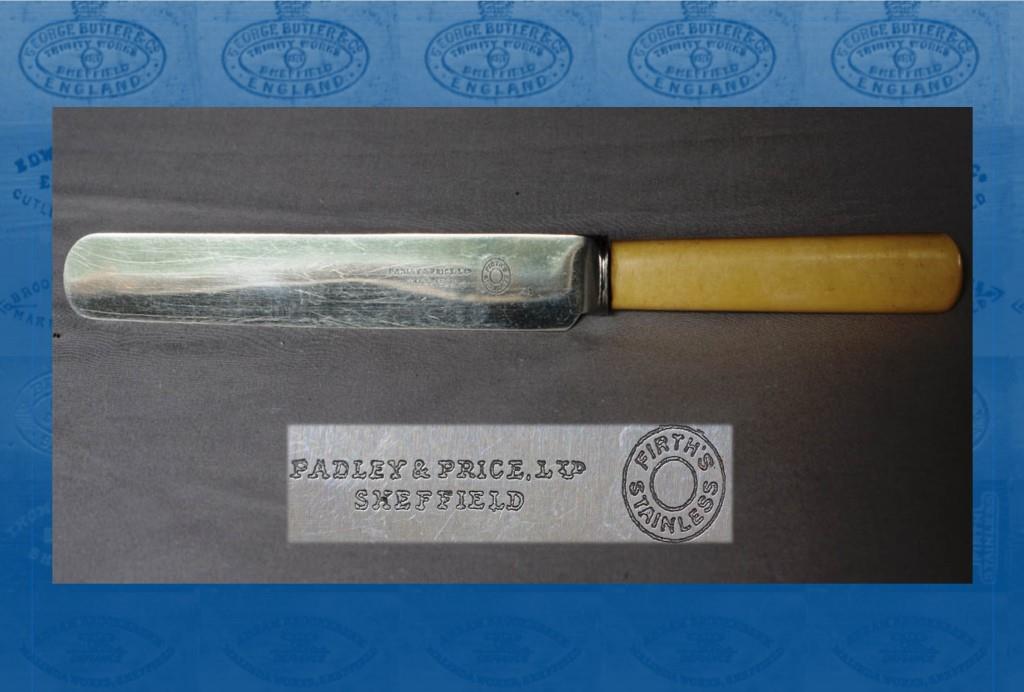
© Ken Hawley Collection Trust - K.0822
Richard Padley (1875-1957) was born in Sheffield, the son of James, a furnace man, and his wife, Sarah. The family lived in Brightside, near the big steel works, but James died when his son was an infant. Richard was variously an iron smith, cashier at a steel works, picture dealer, and ironmonger (on his own account). In 1911, he began to trade in drill steels as a factor. In 1916, he launched R. Padley & Co at Dominion Steel & Tool Works, Hill Street. Padley was joined by Thomas Edward Venables. In 1919, they registered Padley & Venables Ltd, with £30,000 capital, to manufacture drill steels, picks, and pneumatic tools.
Padley was also keenly interested in stainless steel and stainless cutlery. In 1923, he registered Padley & Price as a private limited company to manufacture cutlery, stainless steel, and various tools. Capital was £5,000; the office was at Dominion Steel & Tool Works, Hill Street (Sheffield Daily Telegraph, 13 April 1923). His partner was C. B. Price (of Bromley in Kent). He was probably Charles Bertram Price (1875-1956) who had been born near Liverpool and moved to London, where he prospered as a hardware merchant.
Lacking cutlery expertise himself, Padley acquired J. L. Buxton & Co, a small stainless cutlery and dressing case instrument maker at 184 Howard Road. The firm was run by Joseph Levesley Buxton (1893-1988), who became a Padley & Price employee. A house history of Padley & Venables related how the firm assembled and ground stainless steel table and dessert knives and also made stainless steel sundries, such as bathroom fittings, shoe lifts, and coats hooks – losing a lot of money in the process (Padley & Venables Ltd, 50 Years Golden Jubilee 1911-1961).
Buxton claimed to have a secret formula for mirror-polishing stainless steel. Certainly, Richard Padley recognised the potential of stainless steel for products other than cutlery: notably, household fittings, utensils, and holloware. In about 1925, Padley’s ambitious plans involved the launch of a factory at Blackheath, Birmingham, for the manufacture of finished articles from Firth’s ‘Staybrite’ stainless steel. This alloy, which had been developed by Thos. Firth & Sons Ltd in Sheffield, was more malleable than cutlery stainless steel and so proved ideal for mass market stainless products, such as kitchen sinks. In 1927, Padley dissolved the cutlery business and moved to Birmingham. In the following year, Firth’s acquired a controlling interest in Padley & Price Ltd. Padley became a Firth director.
The arrangement with Firth’s ended in 1932; but Padley & Venables later thrived in Sheffield and Birmingham. Richard Padley died at his home at Edgbaston on 17 January 1957, leaving £39,397 (Quality, January 1957; Birmingham Daily Post, 19 January 1957). Price had died at Chislehurst, Kent, on 11 July 1956, leaving £22,470. Joseph Levesley (now Leavesley) Buxton died at Shirley, Solihull, on 12 July 1988, aged 95. After working for Padley & Price, he had been a sales director for Sheffield tool steel maker Richard W. Carr. An obituarist described him as a pioneer in steel engineering and stainless steel (Evening Mail, 21 July 1988). His estate was valued at £122,380.