


S. M. & Co Ltd

© Ken Hawley Collection Trust - K.1038
The SM & Co Ltd mark seen on this knife may have belonged to Sampson Mordan & Co. Ltd.
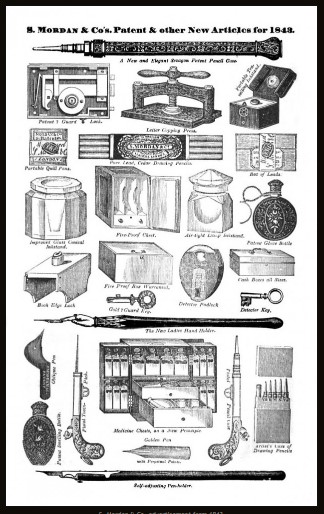
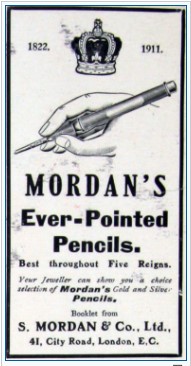
Sampson Mordan (1770-1843) was an apprentice and assistant to Joseph Bramah. He established his own business in 1815 and in 1822, along with co-inventor John Isaac Hawkins, obtained the first patent for a ‘metal pencil with an internal mechanism for propelling the graphite ‘lead’ shaft forward during use’. In 1823 Mordan bought out the rights of Hawkins, entering his first mark (SM oblong) as a ‘smallworker’ in London Assay Office on 9 June 1823. In 1824 he entered a partnership with stationer Gabriel Riddle and registered a new mark (SMGR) in London Assay Office. Under the name S. Mordan &Co. they manufactured and sold their pencils and other writing and stationery related goods from premises at 22 Castle Street, near Finsbury Square, London. The partnership with Riddle was dissolved in 1836 but Mordan continued the business and in about 1842 opened a showroom at 50 Cheapside.
The name S. Mordan & Co. is also associated with lock making. Having trained with Joseph Bramah, Mordan later adapted his former employer’s designs to produce a range of almost identical locks.
Sampson Mordan died in 1843 and the business was taken over by his sons, Sampson Jnr. (1814-1881) and Augustus (1820-1902). By 1865 Mordans were based at 61 City Road and at some point the brothers were joined by Edmund George Johnson and Zachariah Watkins. This partnership was dissolved in 1879. After the death of Sampson Jnr. his brother Augustus was joined by several other partners. In 1898 the firm was converted to a limited liability company as S. Mordan & Co. Ltd. under the control of Harry Lambert Symonds and James Pulley.
In 1933 L.G. Sloan Ltd. became Mordan’s distribution agents and in 1941, following the destruction of the factory by enemy bombing, the name was acquired by Edward Baker of Birmingham. The company went into voluntary liquidation in 1952.
Between the 1820s and 1870s the firm obtained more than 160 patents for various mechanical pencils. In addition to the pencils the company also produced a range of small silver and gold items such as cigarette boxes and cases, flasks, bookmarks, pin cushions, menu holders and folding fruit knives and supplied high class retailers such as The Goldsmiths and Silversmiths Company and Aspreys.