


S. Bright & Company
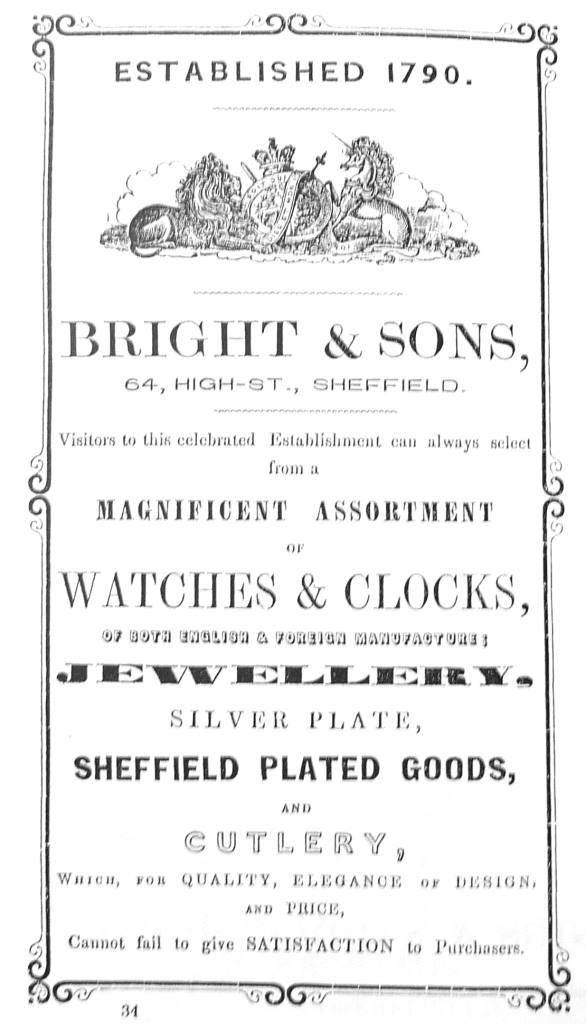
Bright & Sons advertisement. Image courtesy of Geoff Tweedale
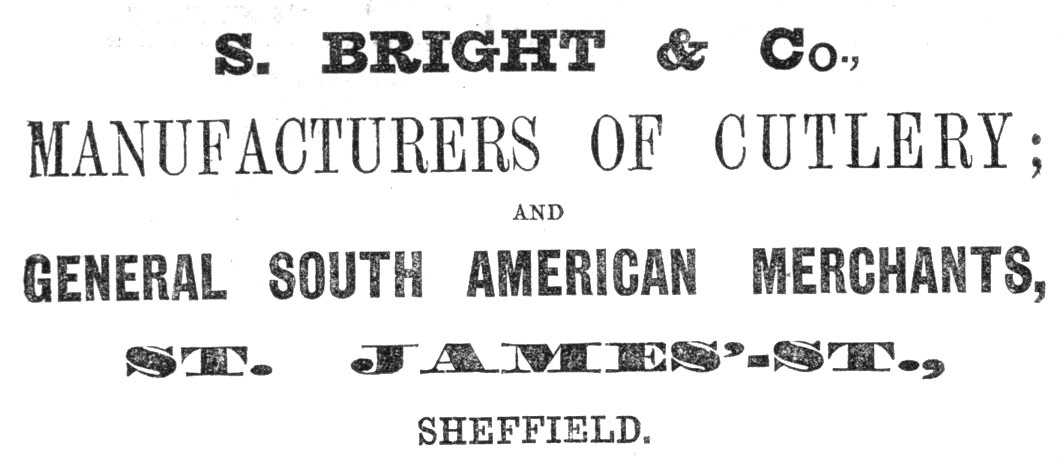
A trade advertisement dated the Bright’s business ventures from 1766. About twenty years later, Isaac Bright (1763-1849) – born ‘in foreign parts’ – and his younger brother Philip Bright (1784-1841) arrived in Sheffield and became jewellers and silversmiths (Lipson, 19471). They were reputedly the first Jewish family to make a mark in the town after opening a shop in Market Place (leading to High Street). One advertisement has an establishment date of 1790. The Sheffield Iris, 26 January 1813, advertised a new Bright shop in Market Place. Isaac married Ann née Micholls (c.1774-1847) and they had ten children. The two eldest sons, Maurice Bright (1796-1848) and Selim Bright (1799-1891) worked in the family business, after their father moved to Leamington in the 1820s to run a jewellery outlet with another son, Henry. Philip later moved to Doncaster to start his own silver and jewellery business.
In the 1820s, Isaac Bright & Sons was a merchant, watchmaker, jeweller, silverplater, and fine cutler in Market Place, Sheffield. In 1831, Maurice and Selim took over the business, which also had a shop in Buxton. But in January 1847 their partnership ended. On 30 August 1848, aged 51, Maurice cut his throat with a razor. The press reported that he had been ‘in a desponding way, owing to the death of his son, the illness of his wife, and the depression of trade’ (Leeds Mercury, 9 September 1848). The inquest verdict was ‘temporary insanity’. The contents of the High Street emporium were auctioned, but during the 1850s Bright & Sons continued to trade in High Street under the direction of Maurice’s widow, Henrietta, and her son, Frederick. By 1861, the business had been sold to Maurice’s assistant, Alfred Draper (Edmund Draper). Henrietta’s sons, Frederick and Herbert, then started a jewellery business in Scarborough. Henrietta died on 24 August 1863, aged 58; Frederick on 24 June 1898 aged 70.
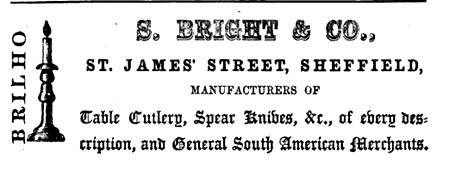
Isaac Bright died in Leamington on 27 July 1849, aged 86, and was buried in Liverpool’s Jewish Deane Road Cemetery. Meanwhile, Selim established himself in Sheffield as Selim Bright & Co, Regent Terrace and Victoria Street. In 1864, S. Bright & Co, St James’s Street, registered a silver mark in Sheffield. The candlestick ‘BRILHO’ mark was also granted. Selim was listed as a ‘manufacturer’ of ‘every description’ of table cutlery, spear knives, and cutlery, and as a South American merchant. But he was essentially a retailer, who also continued the Bright’s jewellery and silverware emporium in The Crescent, Buxton. In 1868, an advertisement for this shop in the ‘centre of the Crescent’ gave an establishment date of 1818. It sold ‘superior’ razors, pen and pocket knives, and table cutlery from ‘their Sheffield manufactory’. Until 1855, Selim partnered Maurice de Lara Bright (c. 1825-1902), his son from his marriage to Estella née de Lara. Maurice later became an iron merchant (and amateur composer of military music).
In 1867, Selim was in the bankruptcy court with unpaid debts. He retired in 1889, aged 90, when the newspapers described him as a well-known jeweller and diamond merchant of Buxton and Sheffield. After spending sixty years in The Crescent, he retired to Liverpool. He died there on 8 January 1891, leaving £928. His descendants continued to play a role in Sheffield life. One of Selim’s sons, Augustus Bright, became a cutlery merchant. Another son, Horatio Bright (1828-1906), became a steel and tool manufacturer. His career is profiled in Tweedale (2020)2.
1 Lipson, E., ‘The Brights of Market Place’, Transactions of Hunter Archaeological Society 6 (1947)
2. Tweedale, G, Directory of Sheffield Tool Manufacturers, 1740-2018 (2020)