


William Batt & Sons
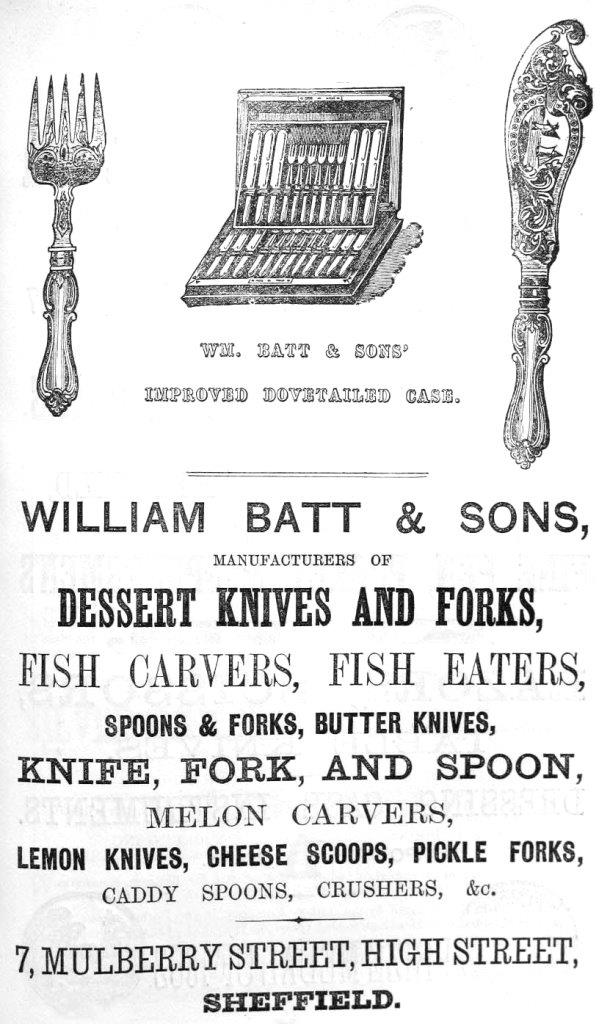
Advertisement from 1868. Image courtesy of Geoff Tweedale
William Batt (1795-1869) was apparently the son of Thomas (a plater) and his wife, Ann. He was a pawnbroker, then an ornamental fender manufacturer, who briefly partnered Thomas Kidgell until 1829. Batt continued in Meadow Street and then Arundel Lane, but was bankrupt in 1838. In the 1840s, he traded as a manufacturer of German silver spoons and forks in Smithfield. By the early 1850s, Batt’s business was in Eldon Street. In 1861, he moved to West End Works, Broomspring Lane, and sold silver-plated table cutlery, such as fish carvers, dessert knives, and butter knives. William Batt died at his residence in Havelock Terrace on 18 December 1869. He and his wife, Mary, had at least eleven children.
In 1863, the business became William Batt & Sons, with sons John, Joseph, and Thomas Nowill as partners (their father retired). Batt’s moved to Mulberry Street (High Street). John Batt left in 1866 and the partners became Joseph, Thomas, and Francis Howard between 1866 and 1870; Joseph and Thomas Nowill Batt between 1870 and 1874; and the latter alone after 1874. In the 1870s, William Batt & Sons moved to Charlotte Street, and then to 17 Sycamore Street (John Batt was at No. 14). The company registered silver marks from Sycamore Street in 1881, 1888, and 1901 (besides a London mark in 1895). The trade mark was crossed cricket bats and ‘WB & S’. Thomas Nowill Batt died at Marlborough House, Marlborough Road, on 24 March 1903, aged 61, and was buried in unconsecrated ground in the General Cemetery. He left £1,010. His sons – Albert Smith (1865-1942), Thomas (1868-1932?), and Arthur (1876-1948) – continued the business. It ceased trading after 1934.