


W. Kilburn Ltd
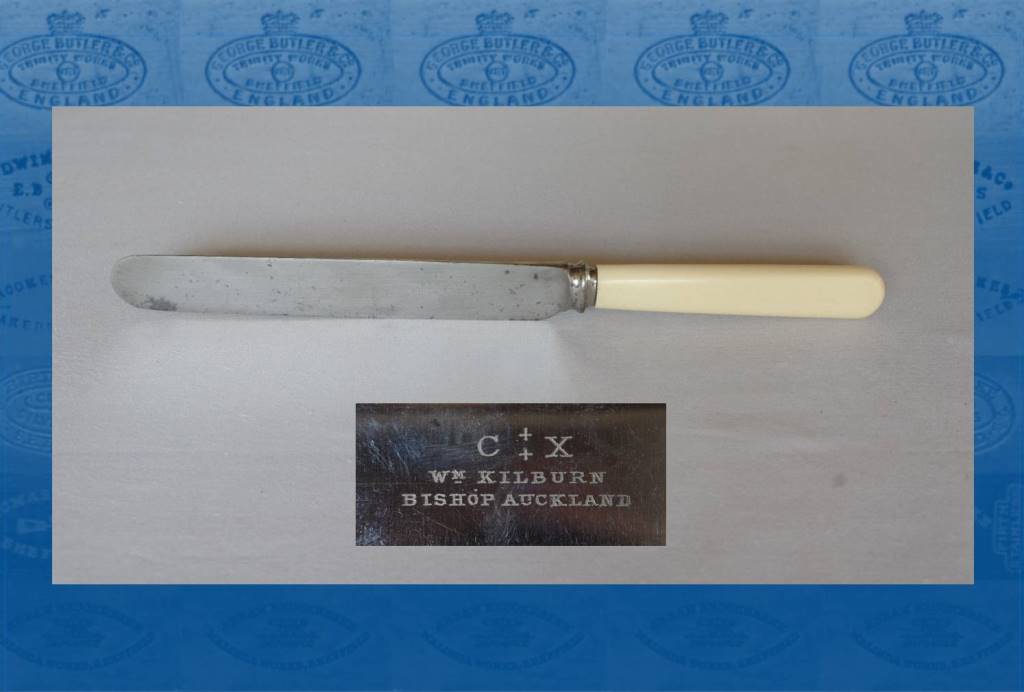
© Ken Hawley Collection Trust - K.1372
The Kilburn family was in business as a wholesale and retail ironmonger at Bishop Auckland, near Durham. In the early nineteenth century, two brothers – Nicholas (1798-1882) and Thomas (1800-1885) – were trading, respectively, as a whitesmith and iron merchant in Newgate Street. By 1851, Nicholas was enumerated in the Census in Newgate Street as an iron merchant, nail. chain, and shovel manufacturer, employing sixteen men. Next door was Thomas (ironmonger) and in the next dwelling was their father, Henry, a retired ironmonger (who died in 1858). By 1871, Thomas employed five men and three boys. After his death in 1885 (leaving £888), his ironmonger’s shop at 21 Newgate Street was operated by his son, William Henry (1849-1927). In the early 1890s, William was in partnership with William Sykes as ironmongers, gas fitters, locksmiths, and plumbers. This was dissolved in 1896.
In the following year, W. Kilburn was registered as a private limited company, with £10,000 capital. The directors were W. H. Kilburn, 21 Newgate Street; B. W. Sant, South Church Lane, Bishop Auckland (who was also managing director of a hydraulic engineers); and R. B. Riley, Coniscliffe House, West Auckland. Kilburn was to be managing director for not less than five years. The firm, which apparently had 34 employees, was described as a wholesale and retail general furnisher and builders, ironmonger, sanitary and water engineer, and kitchen range manufacturer (Northern Echo, 26 November 1897). The firm was wound up in 1914, when Kilburn’s offered for sale its stock of hardware. This included cutlery, which was presumably sourced from Sheffield (Newcastle Journal, 7 February 1914). William Henry Kilburn, of Pond House, Aislaby Sleights, Yorkshire, died on 27 December 1927, aged 78. He left £7,185.