


Richardson Sheffield Ltd
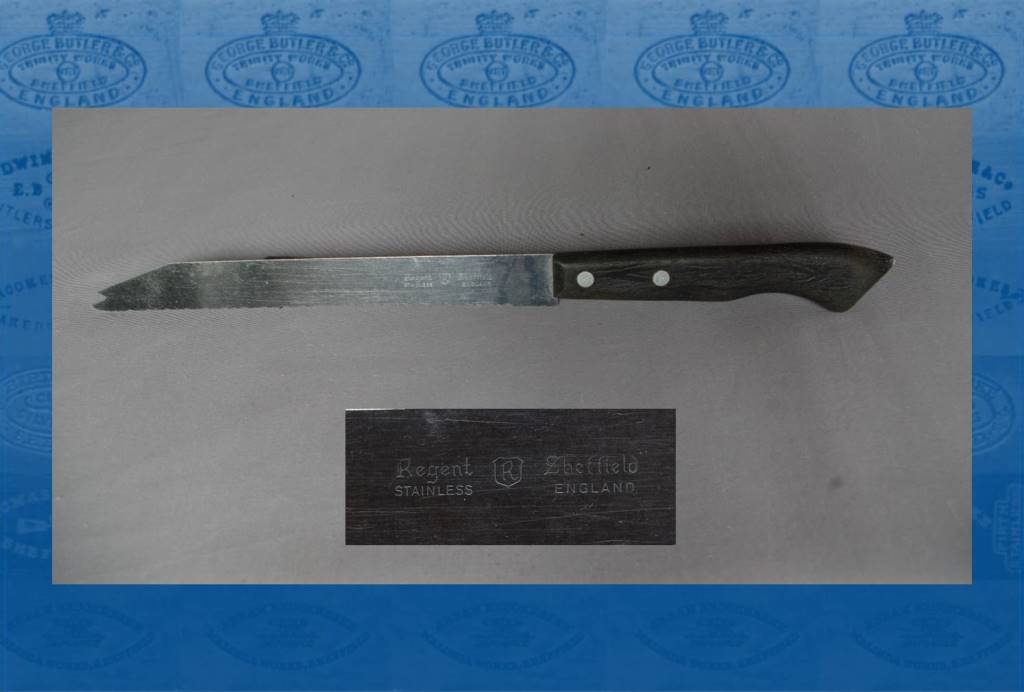
© Ken Hawley Collection Trust - K.1701
This firm originated in New York in 1953, when Jerome (Jerry) Samuel Hahn (1930-2003) – a Brooklyn-born Jewish entrepreneur – launched Regent Sheffield Ltd. He planned to trade on the Sheffield name by marketing stainless kitchen knives worldwide, using a Sheffield factory (Westall Richardson) as a source for knife blades. In 1956, when Westall Richardson proved unable to supply 20,000 blades a week, Hahn bought a half-share in the firm and acquired the remaining shareholding by 1960. He sent over equipment from America and promoted Bryan Upton (who had joined the company in 1959) to managing director in 1966. The company operated as Westall Richardson Ltd from Regent Cutlery Works, Upper Allen Street. Hahn stamped and packaged his cutlery ‘REGENT SHEFFIELD’, though his attempt to register that as a mark in the US was challenged by the Company of Cutlers. ‘EMDEKO’, ‘MIRACLE WORKER’, and ‘DESERT FLOWER’ were other trade names used by Hahn.
In 1966, Hahn and Upton began making complete kitchen knives. To do so, they invested in mechanization, flow production, and computers. They also abolished traditional practices, such as piecework. In 1979, they introduced the ‘Laser’ knife, which proved a marketing success. Linking the high-technology word ‘Laser’ with cutlery proved inspired (many customers believed that the knives were somehow sharpened by laser, but the beam only checked the angle of edge). With a good product, a 25-year guarantee, and an evocative brand name, the firm captured a large share of the kitchen knife market by paying careful attention to the things that Sheffield firms had often neglected: styling and packaging, custom-labelling for large department stores, and speed of delivery. The results were impressive. In the early 1970s, the company’s turnover had been £½m; by 1987 it was over £12m.
In the mid-1980s the firm was restyled as Richardson Sheffield Ltd. In 1986, Hahn sold the business to McPherson’s Ltd, the leading Australian manufacturer of kitchen knives and cutlery, for A$30m. Upton remained, though, and became chairman in 1988. He was helped by a new managing director, Gordon W. Bridge (1944 - 2022), who had joined in 1984. Growth was uninterrupted. By 1993, turnover was nearly £20 million, with profits reinvested. By 1993, Richardson Sheffield had 55 per cent of the UK market in kitchen knives and about 9 per cent of the market in Europe, where it had sales offices in Germany, Italy, and Scandinavia. The firm won two Queen’s Awards for Exports and in 1990 Upton was awarded an OBE for services to exports. This was a striking performance in a declining industry. The company became a favourite of Business School analysts (Grant & Baden-Fuller, 19661; Geroski & Vlassopoulos, 19902). The New York Times, 15 April 1989, headlined how this ‘Sheffield Knife Maker Beats the Odds’.
In 1994, Upton retired. Gordon Bridge became chairman and managing director, but he too moved on in 1995. (He became Master Cutler in 2007; and was awarded an OBE in 2020.) In 1995, the firm (which employed about 400) launched a new ‘Fusion-edge’ knife, which contained tungsten-carbide and was advertised as ‘a knife you will never, ever, ever, ever, have to sharpen in your entire life’. But the fusion-edge knives did not sell well. Unable to respond with more new products, in 2007 a bankrupt Richardson Sheffield was taken over by the Dutch cutlery conglomerate Amefa. In 2022, its address was Amefa GB Ltd at Waterthorpe.
1. Grant, Robert, and Baden-Fuller, Charles, ‘The Richardson Sheffield Story: A Revolution in the Cutlery Industry’, in C Baden-Fuller and Martin Pitt (eds), Strategic Management: An International Case Book on Strategic Management (London, 1996)
2. Geroski, P, and Vlassopoulos, A, ‘A Market Leader in a Declining Industry: Richardson Sheffield’, Economic Review 8 (1990)