


Samuel & James Kirkby
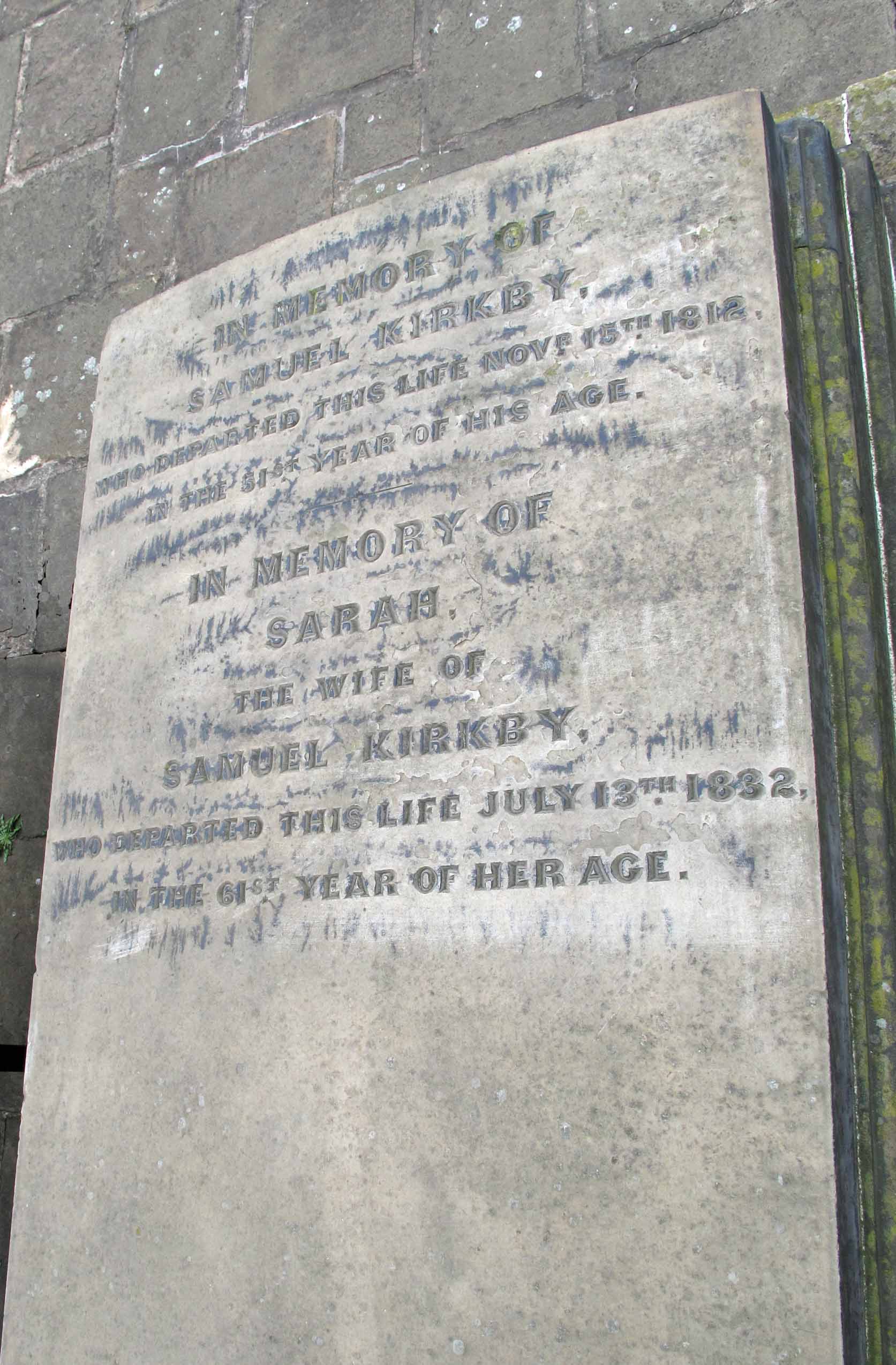
Samuel Kirkby (snr) tombstone in Upper Chapel yard. © Geoffrey Tweedale, 2011
Samuel Kirkby (1762-1812) and James Kirkby (1766-1832) were brothers. They were the sons of James Kirkby (b.1726-?), a butcher, and his wife, Hannah. Their father lived at Button Lane Cottage, Sheffield Moor, and was remembered as a ‘very nice man, who wore a wig’ (Leader, 18761). Samuel and James were apprenticed as cutlers: Samuel to Thomas Nowill; and James to Michael Hunter (after payment of a premium over £5). They became Freemen in 1783 and 1787, respectively. It is not known when they started business. Kirkby is a relatively common name in registers and directories. In 1784, Samuel Kirkby & Co registered a silver mark as a plater at Pond Lane. In 1787, Kirkby & Borwick, pen and pocket knife maker, was listed at Longstone Lane (Old Haymarket). The partners were Samuel Kirkby and John Borwick, using the trade mark ‘ESAU SULTAN’. This enterprise was dissolved in the same year.
By 1797, the picture becomes clearer: Samuel & James Kirkby appeared in a directory as a pen and pocket knife cutler at Carver Street (trade mark ‘KIRKBY’). Carver Street was also home to plated goods maker Kirkbys, Waterhouse & Co. These firms may have been coterminous, as regards ownership. In 1790, Samuel Kirkby had married Sarah Hodgson (c.1771-1832), the daughter of a Nantwich minister. Soon the Kirkby family (including Samuel and James) and the Hodgsons became intertwined in the silver plate trade (see Blagden, Hodgson & Co; Waterhouse, Hatfield & Co). In 1807, Samuel and James ended their cutlery partnership. While James concentrated on silver plated goods (registering a silver mark in 1809), Samuel apparently next partnered Robert Wass (dissolved in 1810). In 1811, Samuel Kirkby was listed as a pen, pocket, and fruit knife manufacturer. According to the Assay Office, in the following year Samuel Kirkby registered a mark for general silver wares: ‘KIRKBY FOR USE’ (Sheffield Assay Office, 1908). He developed a flourishing business and lived at Grove House (Pitsmoor).
The Kirkbys were nonconformist and worshipped at Upper Chapel in Norfolk Street. (Benjamin Kirkby, Master Cutler in 1686, had been a trustee of the Chapel.) On Sunday 15 November 1812, Samuel attended service and was returning home with his son, when:
the horse took fright at the noise of the drums of the South Devon Militia … and ran furiously down Waingate. Near the bridge Mr Kirkby and his son were both thrown out of the carriage; and by the fall the skull of the former was fractured in so dreadful a manner, that he died in less than an hour afterwards – his son too was much hurt. Another person, Mr William Darling, publican, was also seriously injured by being knocked down and run over in attempting to stop the horse, – and we are informed he now lies dangerously ill (Statesman [London], 20 November 1812).
Samuel Kirkby was buried at Upper Chapel five days later, the register noting that his remains were ‘inclosed [sic] with a 10 inch brick wall’. The Kirkby tomb is in the Chapel Yard. Samuel’s son, Samuel (1794-1855), had been baptised at Nantwich. He had survived the gig mishap and continued his father’s business as a silver fruit knife maker at High Street. By 1821, he was partnered by William Kirkby, who is unidentified.
In 1821, Samuel & William Kirkby was listed at 18 High Street as a merchant and manufacturer of all types of cutlery, including silver fruit and dessert knives. In that year, the partners registered a silver mark (‘SK’) as plate workers in High Street. Subsequent addresses were Eyre Lane, Duke Lane, and Eyre Street. The firm had a branch in Hamburg (William Kirkby & Co). In 1839, the partnership was dissolved. Samuel retired to the Isle of Man. In the Census (1851), he was living at Ballaugh on the island as a ‘gentleman by annuity’, aged 56. His wife was Sophia (the daughter of Alexander Whitehead, late secretary to His Majesty’s Transport Board), whom he had married in 1837 at St Mary’s, Lambeth. Samuel, ‘late of the Elm’, near Sheffield, died at Douglas, Isle of Man, on 4 December 1855. He was buried at Onchan cemetery. Sophia died in 1872, leaving under £5,000. William Kirkby’s later life has not been traced: perhaps he died in Hamburg.
1. Leader, Robert E., Reminiscences of Old Sheffield (Sheffield, 2nd edn. 1876)