


Peter Goss
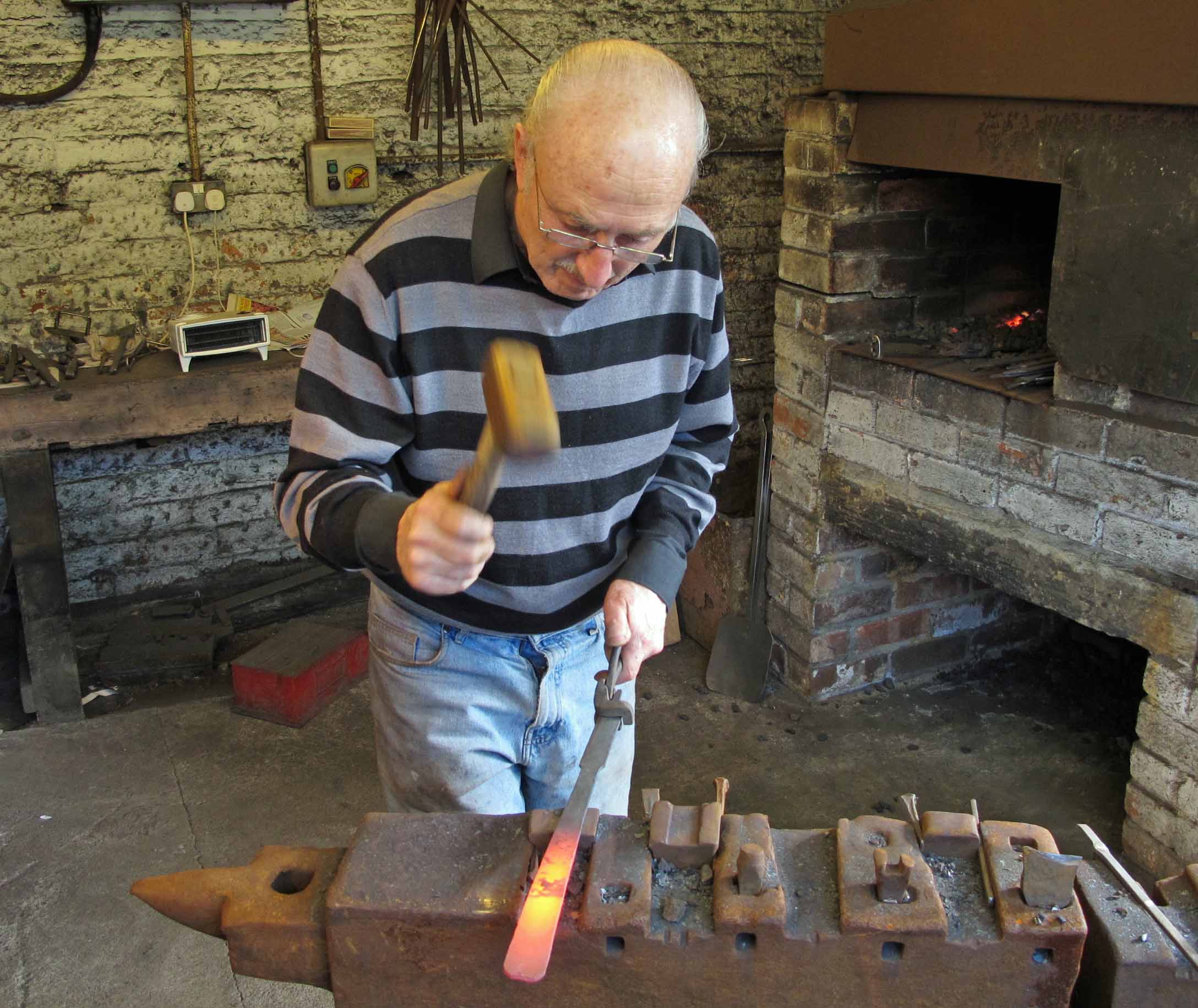
Pete Goss in 2012, © Geoffrey Tweedale
Peter A.Goss was born at Firth Park in Sheffield in 1940. He was educated at Walkley County School. When he left, aged 15, he found a job as a bricklayer. The working conditions were awful and his hands were soon a wreck. He left after three weeks. However, he had an uncle at William Skidmore, the surgical instrument manufacturer. This firm had been founded in the nineteenth century and for many years was based at the quaintly-named Enema Works in Cemetery Road. Peter began surgical instrument forging. He recalled that Skidmore’s had about four forgers on the premises, who manufactured a wide range of forceps, clamps, pliers, and other items too numerous (or grisly) to mention.
There was no formal apprenticeship. Peter was expected to pick the job up himself. He considered that he was competent at forging by the time he was 18: certainly by then, he had his own ‘price list’ of tools he could make. It was all piece work. Eventually, he was the only forger remaining. The hand-forged surgical instrument – like the hand-forged pocket-knife – succumbed to competition from items that were cast, stamped, or otherwise machined. In about 1970, after Skidmore’s suffered an inevitable takeover, he left and continued forging alone as a ‘little mester’. In 1988, he moved to Kelham Island Museum. The closure of surgical instrument firms helped him initially, because he soon had plenty of orders from their customers – some from London.
On visits to Kelham, the author watched Peter at his forge and chatted about his work. It was easy to see why forging had attracted no fresh recruits. It was hard work, aside from the declining market for hand-forged instruments. He did not cloak forging in mystique. He had always worked with stainless steel (the best material for surgery), never carbon. He did not claim to hammer quality into the steel or modify the material’s structure. ‘Stainless is too hard. When I have finished with it, a drill won’t touch it’ (author’s interview, 28 May 2015). He did, though, emphasize the skill involved. ‘It’s all about hand and eye co-ordination. Not everyone can do it’.
On one visit, he directed my attention towards his forging block, with its numerous ‘gates’ and ‘dies’. Each one had a use for a specific type of work or instrument. ‘We made the dies ourselves. Unlike other trades, such as scythes or pocket-knives, surgical instrument forging needs an array of dies’. Other skills involved judging the temperature of the steel by eye alone. I once watched and photographed him making a pair of special forceps for removing tonsils. They were box-jointed. Having heated the steel in the fire, he expertly formed the loops with a few hammer blows on a pointed die.
Peter was still receiving the occasional order from surgical instrument suppliers. As the last hand-forger, he had no competitors. His parting comment: ‘This Xmas [2015], I’ll have worked 60 years as a surgical instrument forger. Yet I’ve got no aches or pains – and no arthritis in my wrist or hands!’ When the Covid-19 virus began retreating, he continued to work the occasional day at Kelham. Aged 81, he recognized that the trade was at an end. He told one reporter: ‘This isn’t a living, it’s a hobby’ (Hollingworth, 2021). A short film of Peter Goss hand forging (2006) can be viewed on the Ken Hawley Collection Trust YouTube Channel (Hawley Original Film Series).