


Edwin Blyde & Company Ltd
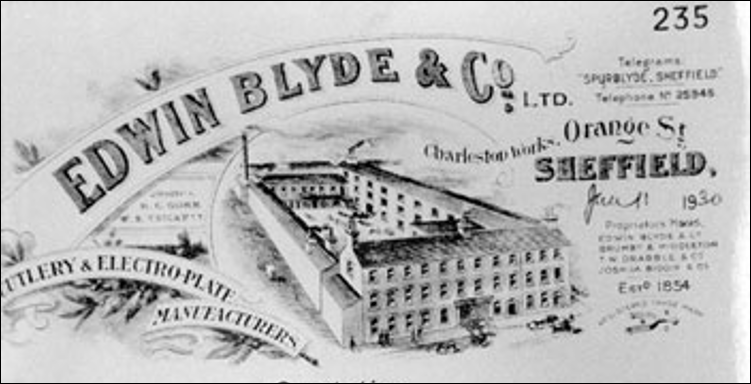
© SCC Picture Sheffield [u04119] - image of the Charleston Works


Trade catalogues for Edwin Blyde (1843-1914) carried an establishment date of 1798 (though twentieth-century letterheads stated 1854). The first partnership between Edwin and William Blyde, cutlery manufacturers and factors, was listed in Eyre Street in 1860. They were the sons of James Blyde. Sarah Ellison Blyde (1836-1897), their sister, also became a partner and the address became Howard Works, Howard Street. However, in 1864 William and Sarah fell out. The Sheffield Independent, 3 December 1864, carried advertisements in which Sarah claimed she had sacked William, while the latter claimed he remained a partner. This was apparently resolved when the business very briefly became Blyde Brothers, Eyre Street, a manufacturer of cutlery and surgical instruments. W. & E. Blyde & Co was dissolved in 1865.
According to Golden Years of Sheffield (2000), Edwin was a wheeler-dealer, which accounts for his complicated business biography. He began operating as a merchant and manufacturer of cutlery in Eyre Street (1868) and then Charles Street (1871). In 1871, Edwin, a cutlery merchant (aged 28), was living in Havelock Street, with his wife Martha (later they had a son, Joseph). By 1876, Edwin Blyde & Co was operating at 24 Bow Street (as sewing-machine makers and dealers) and at Charleston Works, Rockingham Street (making cutlery, surgical instruments, plated goods and juvenile tool chests). The corporate mark was a spur, with the letters ‘EBS’, registered in 1871. Another mark appeared in early Blyde catalogues: this was ‘C.I. Wingard, 1854’ (Carl J. Wingaard).
By 1879, Blyde’s Charleston Works was in Lambert Street. In that year, Blyde exhibited at the Cutlers’ Exhibition in London a case of instruments for opening cans of fish (Sheffield Independent, 5 May 1879). In 1884, a trade advertisement stated (obscurely) that the business was ‘late Taylor, formerly Deakin’s, established 1798’ and gave prominence to cutlery, tin-opener knives, and sardine knives. Blyde lived at Pembroke Villa, Northumberland Road. The firm transferred to Orange Street in 1896, when Blyde acquired an interest in Brumby & Middleton, with Herbert Bramble Middleton as his partner. The firm was styled as ‘Cutlery and Electroplate Manufacturers’. A silver mark was registered in 1901 under the name Blyde & Middleton (‘B&M’), Charleston Works, Orange Street. However, in 1902 Blyde’s partnership with Middleton was dissolved, leaving Edwin Blyde & Co as the sole business entity. Blyde registered a silver mark under that name in 1907. Two years previously, Edwin Blyde had featured in a notable legal case, after he had supplied a London retailer with cutlery marked ‘Mappin & Sons’. In 1886, Blyde had purchased the old name of Mappin & Sons (see James Mappin) and registered it in 1888, though an attempt to register a similar plate mark failed. In 1905, Mappin & Webb succeeded in obtaining an injunction restraining the use of the name. Nevertheless, Blyde prospered and resided in Storth Lane, Ranmoor. He died on 17 June 1914, aged 71, and was buried in the unconsecrated section of the General Cemetery. He left £7,636.
In 1912, Blyde had sold out to Walter Trickett (1869-1926). He was the son of cutler James Trickett and his wife, Elizabeth. Walter registered a silver mark in 1894 from Holly Street. He adopted the ‘SPUR’ mark and the name, ‘Joshua Biggin & Co 1854’. ‘FAUGH A BALLAGH’ and ‘VOLUNTEER’ also appeared as Blyde marks. Walter specialised in spoons and forks in workshops on the corner of Holly Street/Trippet Lane. The Blyde takeover gave Walter the chance to expand the cutlery side of the company, especially canteens. A member of the Plymouth Brethren, he died on 20 August 1926 after collapsing while preaching on the sands at Llandudno. He left £17,542. His tomb is in Norton cemetery. His eldest son, (Walter) Stanley (1901-1982) – who had started at Blyde’s in 1915 – took over. Stanley’s brother, (Edric) Ronald (1908-1990), also joined the firm.
In 1928, separate companies were registered. The first was Edwin Blyde & Co Ltd, with £8,000 capital, at Orange Street. W. S. Trickett and Henry Cooper Gomm (1883-1966) were the directors. The second was Walter Trickett & Co Ltd, with £5,000 capital, at Anglo Works in Trippet Lane. The directors were Walter’s widow, Ada Trickett (1875-1959), and Henry Cooper Gomm. After the 1940s, Anglo Works in Trippet Lane was run by Ronald Trickett (using the ‘Primus’ mark of Isaac Ellis. Stanley continued to operate Edwin Blyde & Co in Orange Street. He began concentrating on pewter (after the takeover of adjacent pewter business of James Furniss Ltd). Blyde’s manufactured pewter ware at Orange Street into the 1970s, but in 1980 under Stanley’s son, Dennis Trickett, it moved to Charleston Works, Little London Road. Walter Trickett & Co Ltd was sold to Jim Spiers and operated until 1989 (Jenkins & McClarence, 19891). The derelict Anglo Works was renovated in 2006. The Trickett name passed to Chimo Holdings. In 2022, Edwin Blyde Pewter was based at Darnall, Sheffield, with members of the Trickett family still involved.
1. Jenkins, C, and McClarence, S, On the Knife Edge (Sheffield, 1989)
