


Joseph Kirkby & Sons
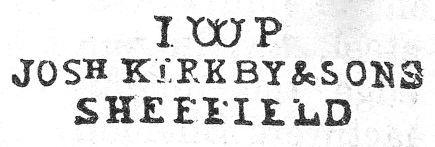
Trademark from 1868 Directory. Image courtesy of Geoff Tweedale
The founder of this firm apparently had a varied career. Joseph Kirkby was probably baptised on 22 January 1768, the son of Samuel (a cutler). Apprenticeship records suggest that he may have started training with his father in 1781 and become a Freeman in 1795. In the same year, he married Hannah Cuttler (c.1777-1869). It is difficult to follow his early career in local directories, but he specialised in silver plate. He may have operated Smith, Kirkby & Co, which was active by 1790 in Lambert Street. The partners were Joseph Kirkby, Benjamin Rawson Smith, and Thomas Kitchen. The latter left in 1790, but Smith & Kirkby continued at Lambert Street. It was later dissolved and in the directory (1797) Joseph Kirkby was listed alone as a plate worker at 14 Lambert Street. In 1800, he registered a silver mark.
Joseph Kirkby’s name did not appear in the Sheffield directory in 1811. The next appearance of Joseph Kirkby – presumably the same man – was in 1816 and 1818. He was a listed as a filesmith at Fargate. In the early 1820s, Joseph Kirkby & Co was listed as a merchant and file manufacturer at Steelhouse Lane. Joseph Kirkby, merchant, ‘deservedly regretted’ died on 29 November 1824, aged 58 (Sheffield Independent, 4 December 1824). He was buried in St Paul’s churchyard.
The business moved to Portobello Street under new partners. These included Joseph’s son, Samuel Kirkby (bapt.1798-1882), George John Healey (who had married one of Joseph’s daughters), and Francis White. This arrangement ended in 1832 and the Portobello workshops were vacated. Samuel took over the firm – now named Joseph Kirkby & Son, merchant at West Street. By 1837, it occupied part of George Wostenholm’s Rockingham Works, in Rockingham Street. Kirkby’s was listed as a merchant and table, pen, pocket, and razor manufacturer. In the 1840s, Samuel’s younger brother, John Kirkby (1810-1864), joined the firm, which became Joseph Kirkby & Sons. In 1853, Samuel Kirkby retired and John continued the business. The latter lived at Glossop Road, but died ‘suddenly’ at Bradwell on 5 December 1864, aged 54. He had returned home after a day’s shooting, retired to bed, and within hours ‘became exceedingly sick, and while thus suffering burst a blood vessel’ (Sheffield Independent, 7 December 1864). He was buried in the General Cemetery. He left under £3,000 and a widow, Clara Arabella. She died at Brighton on 28 July 1881, leaving an estate resworn at £8,561.
After relocating to Eyre Lane in 1868, the business apparently became defunct. Samuel Kirkby, Broomgrove Crescent, died on 11 February 1882, aged 84, the ‘eldest and last surviving son of the late Joseph Kirkby, merchant, of this city’ (Sheffield Daily Telegraph, 18 February 1882). He was interred in the General Cemetery. He left a personal estate of £1,573. In the same grave lies Hannah Kirkby (died 1869, aged 92), who had lived in her later years with Samuel. The Kirkby trade mark (a double candlestick device, with letters ‘I’ and ‘P’) was acquired by Gem and Field.