


J. Moore & Company
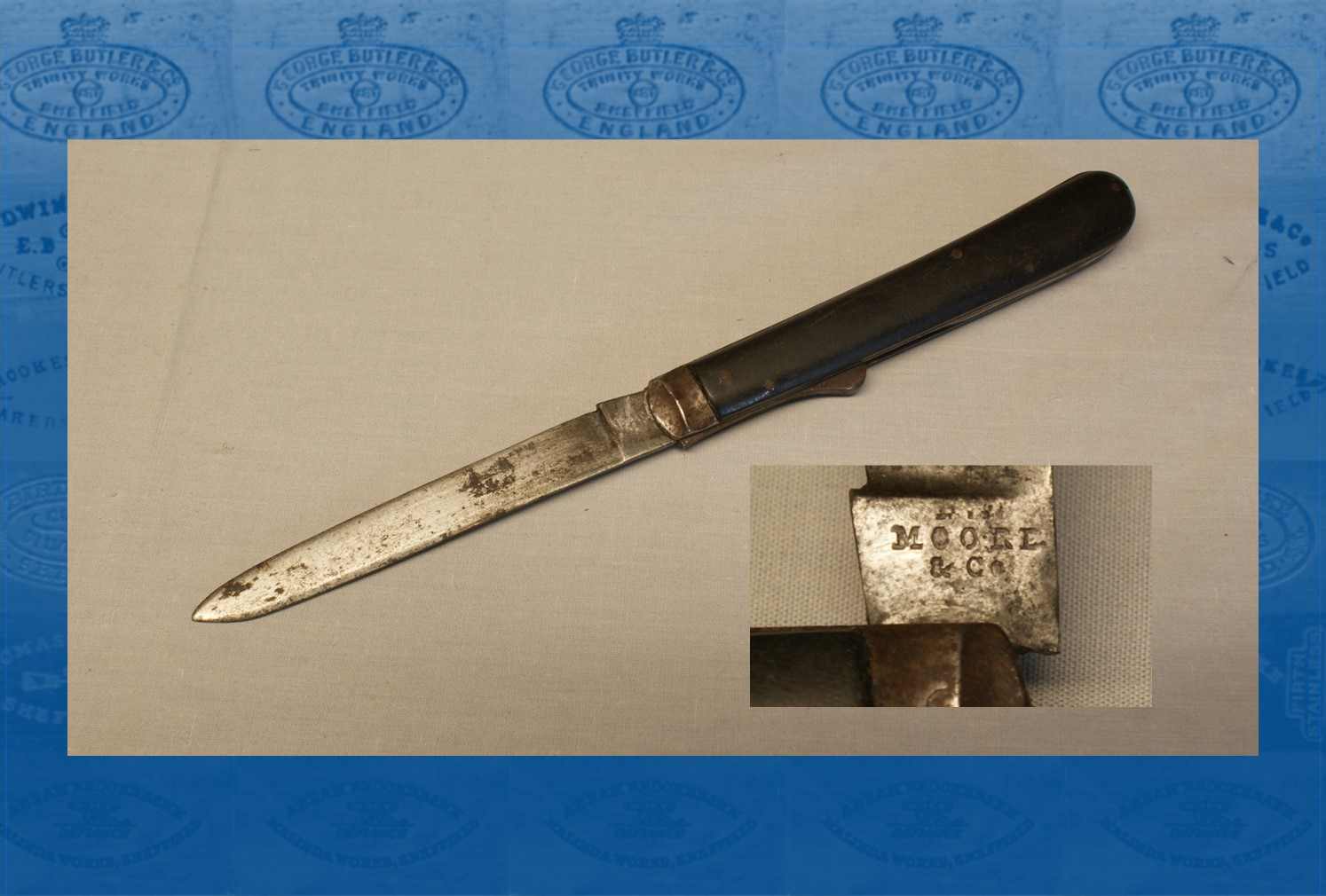
Lock knife, probably made in Sheffield in the late 19th-century. © Ken Hawley Collection Trust - DS.168
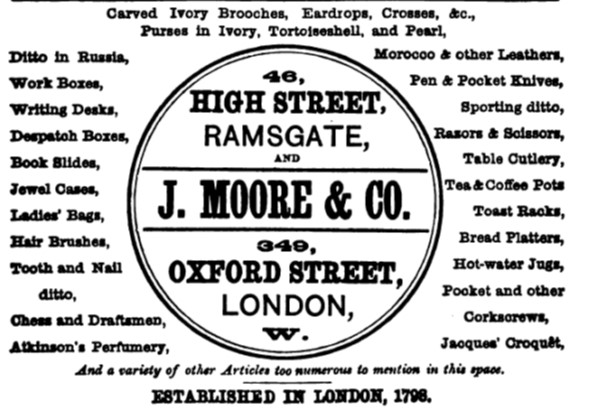
In the early nineteenth century, James Moore was listed in London directories as a ‘working cutler’ and razor maker at 349 Oxford Street. Later advertisements claimed an establishment date of 1798. He was once burgled and at the trial of the woman who was later convicted (and sentenced to seven years’ transportation), the following were listed: 480 table knives (value £40); 480 table forks (£20); 180 penknives (£50); 96 pairs of scissors (£6); 48 pairs of snuffers (£12); 18 carving knives (£3); 18 carving forks (£1); and 36 corkscrews (£5) (Proceedings of the Old Bailey, 2 December 1818).
In the Census (1851), James Moore was enumerated at 349 Oxford Street as a 62-year-old cutler (born at Aldersgate). He was living and working with his son-in-law, John Arnold (aged 41), who had married Ann, James’ daughter. James Moore probably died in 1852. John Arnold continued to live and work as a cutler at No. 349, alongside William Foster, an ivory turner and comb maker. In 1865, J. Moore & Co was launched, with a branch shop at High Street, Ramsgate, operated by John Arnold’s son, Alfred (1846-1891). The shop sold everything from cutlery to brooches, ladies’ bags, brushes, perfumery, and skates. Alfred died on 9 June 1877, leaving £458 to his widow, Elizabeth. She continued to run the shop at Ramsgate, until its closure in 1895.
J. Moore continued to trade as a cutler, ivory turner, and brush maker. Like other cutlery retailers along Oxford Street (for example, Mappin & Webb), Moore’s dealt extensively in fancy goods and novelties, such as dressing cases, hairbrushes, reading lamps, silver match boxes, tea infusers, and boys’ tool sets (made in Sheffield). Moore’s cutlery, too, would have been sourced from Sheffield. Moore’s advertisements featured a cycle knife (which had inscribed on the handles lighting-up times for the year) and a sportsman’s knife (with dials on the side for scoring game when shooting). In 1902, one of Moore’s knives was used as a murder weapon. Mr James Moore (a descendant of the founder?) told an inquest jury how a young woman, Miss Kitty Byron, had entered his shop (by then at No. 211 Oxford Street) and asked for ‘a long single-bladed knife’. Moore showed her a lock knife. Before purchasing it for 5s 6d (about 25p), she had asked: ‘Is it nice and sharp?’ On leaving the shop, she headed for Mansion House and plunged the knife repeatedly into her lover – a 45-year-old married stockbroker, Arthur Reginald Baker (The Echo, 17 November 1902). She was sentenced to death, but after the case became a cause célèbre, she was released after five years (‘The Stockbroker and the Girl’, Sunday Express, 22 September 1929).
In 1905, a London directory listed J. Moore (‘the oldest house in Oxford Street’) as an ivory turner and brush maker at 211 Oxford Street and Fenchurch Street. Its last advertisements featured ladies’ handbags. J. Moore apparently ceased trading in about 1913.