


Marsh Brothers & Company Ltd (Marshes & Shepherd)
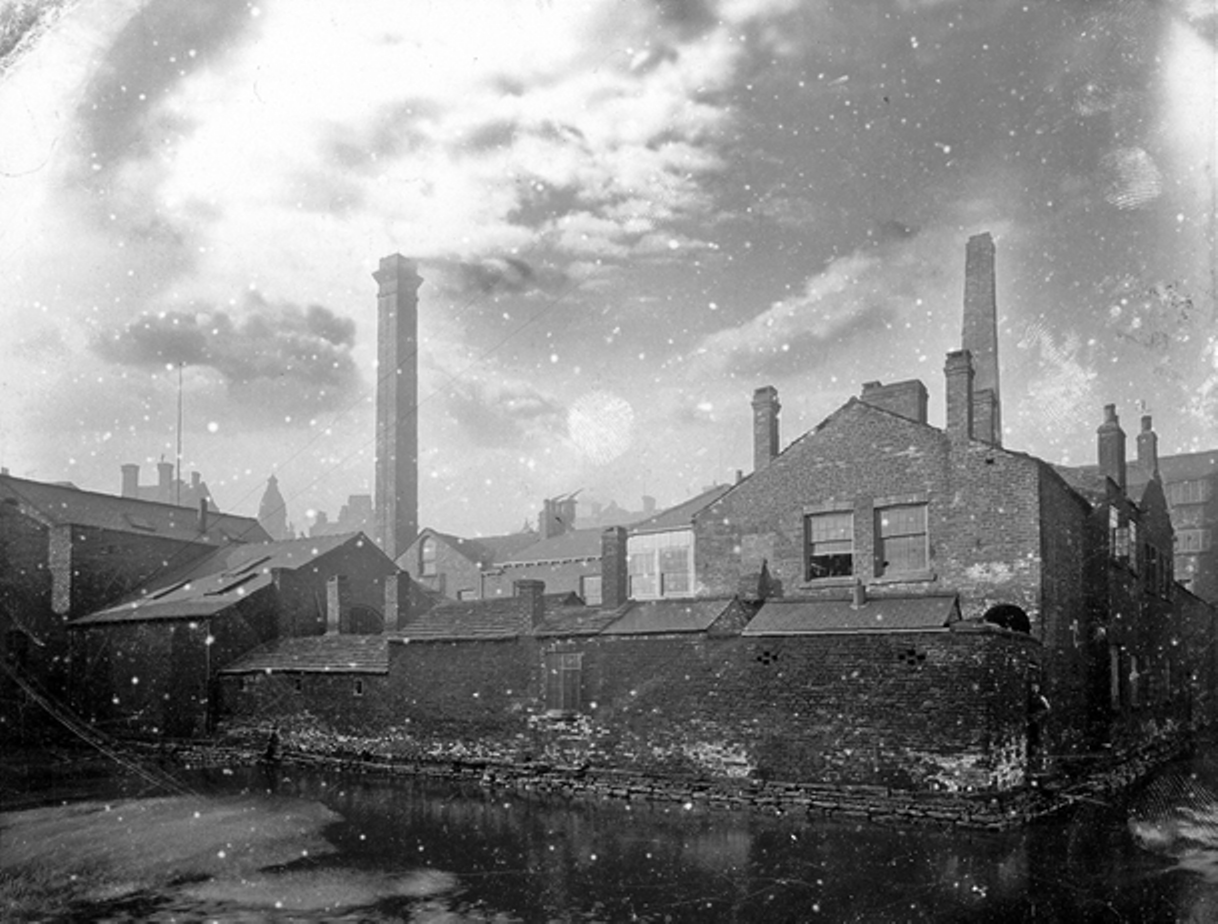
Marsh Brothers, Steel manufacturers, Ponds Works, (fronting Shude Lane), right, William Jessop's Soho Rolling Mills, left (includes square chimney). Ponds Dam, foreground (fed by River Sheaf); Picture Sheffield (s02116), © SCC
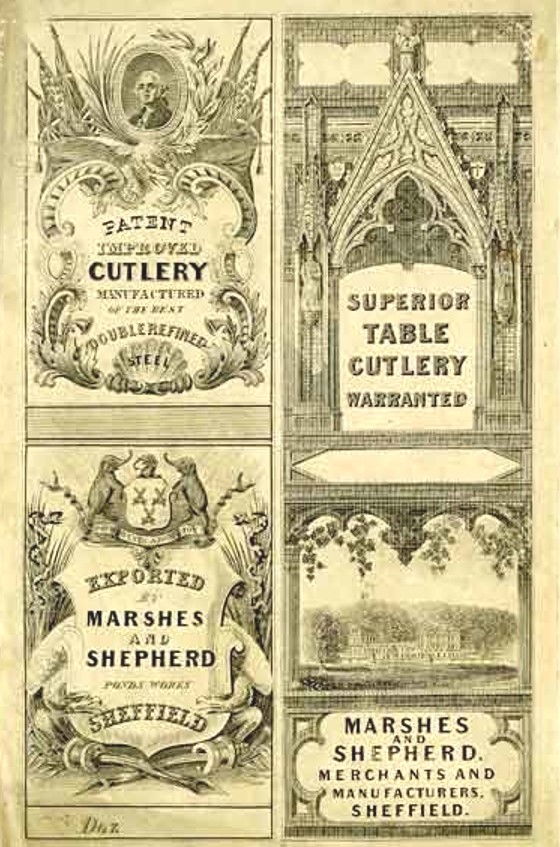

The history of the Marsh cutlery family has been traced to 1631. By the late eighteenth century, the family had settled as spring knife cutlers in the Park district of Sheffield, where William Marsh & Son was listed in a directory in 1774. William Marsh (1737?-1780) had been granted his Freedom in 1758, when he acquired a mark featuring a Maltese Cross and the letter ‘y’, surmounted by a crown. This had been granted in 1713 to Samuel Shepherd – a family with which the Marshes became linked. (Detailed pedigrees of these families have been published in Sidney Pollard’s history of Marsh Bros, 1954, and in T. Walker Hall, 1915.) William’s widow, Hannah, took over the business for a time, before her son, James Marsh (1761-1841), began expanding the business.
James Marsh & Co was established in 1810. It moved from Park to Castle Hill in about 1815 and then in 1822 to Porter Street. James retired in 1819, when his firm’s capital was £10,000. He had already brought his sons, by his wife Margaret – William Marsh (bapt.1789-1860) and John Marsh (1791-1858) – into the firm. Also involved was James’s son-in-law, Thomas Shepherd (c.1806-1845). The latter became the senior partner and by the mid-1820s the firm was styled Marshes & Shepherd. Its products were particularly in demand in the USA, where another son of James – James Marsh (1792-1878) – was the agent in Philadelphia. In 1825, an American visited the ‘extensive establishment of Messrs Shepherd & Marsh’ and wrote that they:
are largely concerned in the manufacture of table knives, pen knives, and other species of cutlery. Every process, however minute, from the forging of the blade to the last polish of the handle, was pointed out. The labour is greatly abridged and expedited by the use of moulds, frequently giving shape at a single stroke of the hammer. One of the most curious operations is the preparation of the horn for handles. It is softened by the combined influence of fire and water, and then pressed into form by hot iron plates, the material coming out of the mould highly polished' (Carter, 18271).
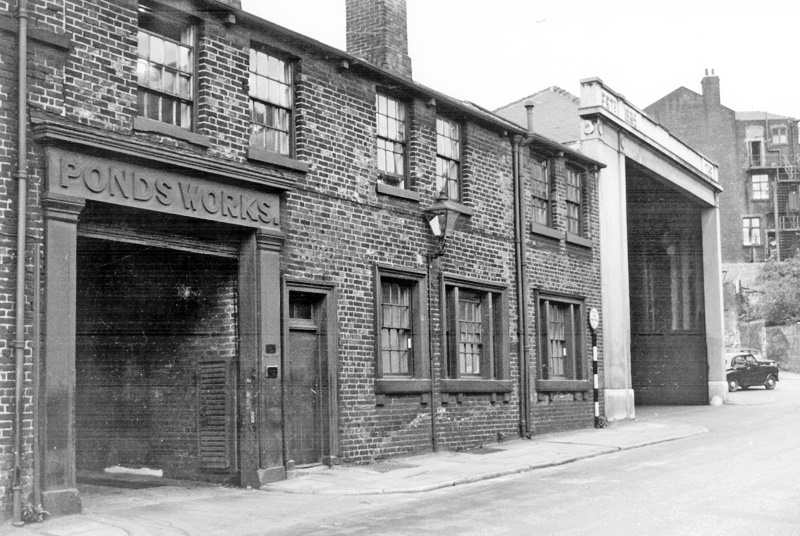
In 1828, Marshes & Shepherd moved to Ponds Works, Forge Lane. This was near Baker’s Hill and in an area notable for its streams, millponds, dams and goits (now the site of Ponds Forge sports centre). It was a typical courtyard-style factory, with house and garden, warehouse, counting house, forge, old waterwheels, crucible steel furnace, rolling mill, grindstones and engine house. All that was lacking was a set of converting furnaces for blister steel. In the 1830s, the firm erected those, too, at nearby Navigation Works. By the end of the 1840s, it had steelmaking capacity at Columbia Works, which had been vacated by John Brown.
Between 1828 and 1837, capital rose from £28,000 to £58,000, as the firm began to market steel, saws, files, and many different types of edge tools. In 1838, it acquired the tool business of James Cam (see Cam & Birks). As the firm’s historian wrote: ‘To maintain the high quality of these varied goods must, by itself, be ranked as a great achievement of the partners, who had made their way up in the world from small masters of spring knife cutlery in one generation’ (Pollard, 1954). The company’s name could be found on pocket knives, table cutlery, butchers’ and palette knives, scissors, and razors. Many of these products were commissioned from outworkers. Further trade marks were acquired, including ‘ROXO’ (which was granted to Thomas Shepherd in 1833 and used on razors) and the ‘BEAVER’. ‘JOHN ADWICK’ was first stamped on razors in 1871 and the name was listed in directories at Ponds Works until the early 1930s, though the identity of Adwick remains a mystery. (However, a warehouseman of that name is known to have worked at Marsh Bros.) In 1927, the marks of Hargreaves, Smith & Co were also purchased.
In 1850, Marshes & Shepherd was dissolved, and Marsh Bros & Co was formed by William and John Marsh. The firm displayed at the Great Exhibition (1851), where it won an Honourable Mention, and the New York Exhibition (1853). By 1862 – when Marsh Bros won a medal at the International Exhibition (1862) for a ‘good assortment of tools and cutlery’ – about 250 workers were employed. Despite problems with financial fluctuations and unpaid bills, the American trade continued to be a major factor in the firm’s expansion in the 1850s and 1860s. The firm had resident agents in Philadelphia and New York (besides connections in New Orleans and Boston), and these were often Marsh family members. For example, Theophilus Marsh (1826-1881), the son of John, lived in New York. In America, additional partners were recruited, such as William Newton Woodcock (who died on 11 August 1869 at his residence in Ravenswood, Long Island).
The Marsh Bros’ partners were among the wealthiest men in Sheffield. John Marsh lived at Lydgate Hall, Crosspool (later acquired by Horatio Bright – see S. Bright). His life ended tragically. On 23 March 1858, his carriage overturned in Fulwood after the horse had bolted (Sheffield Independent, 27 March 1858). His wife was killed; John succumbed to angina, aggravated by his injuries, on 22 April 1858, aged 67. He was buried in the General Cemetery, leaving £35,000. His brother, William Marsh, Clough Bank, late of Canklow Hall, near Rotherham, died on 24 January 1860, aged 70. He left £20,000. Theophilus Marsh died in Sheffield on 21 November 1881, aged 55, apparently from heart disease. He was buried in the General Cemetery, leaving £32,856.
Despite these deaths, Marsh Bros & Co remained in family hands. But the decline of the firm’s cutlery business after the 1880s (caused partly by American tariffs) prompted Marsh Bros to abandon cutlery production, apart from razors (which were subcontracted to J. & W. Pitchford). It decided to concentrate on making tool steels and engineers’ tools (becoming ‘Ltd’ in 1907, with £30,000 capital). Marsh Bros & Co Ltd continued to trade as a steel and tool maker until the 1960s. Further details on this firm can be found in G. Tweedale, Directory of Sheffield Tool Manufacturers, 1740-2018 (2020).
1. Carter, Nathaniel H, Letters from Europe … in the Years 1825, ’26, and ’27 (New York, 2 vols, 1827)