Harrison Brothers & Howson

George Howson. Image courtesy of Geoff Tweedale
This was one of the biggest cutlery firms in Sheffield by 1900. It can be traced to George Howson (c.1788-1847), whose background is obscure. Cutlers named Howson are listed in the records of the Company of Cutlers and one was apprenticed as a cutler in 1803 (but the identification is uncertain). Certainly in about 1820, George Howson joined Thomas Sansom & Sons and worked his way up from merchant’s clerk and accountant to partner. He died at his residence at Norfolk Street on 9 December 1847, aged 59, and was buried at St Mary’s churchyard, Bramall Lane. George’s son, William Howson (10 February 1822-5 July 1884), joined the Sansom business.
In 1849, William Howson partnered two brothers – James William Harrison (1816-1897) and Henry Harrison (c.1825-1893) – and the trio took over Sansom to form Harrison Brothers & Howson. (Later company advertisements dated the enterprise from 1836, but this may relate to the trade mark). The capital of the business at 45 Norfolk Street was £7,000. The mother of the Harrisons had once been married to John Brocksopp, a Derbyshire ironmaster, so that linkage helped finance the new venture (Jenkins, 19961).
William Howson became traveller for the firm, while Henry Harrison moved to America. The company had agents in New York City during the 1850s and 1860s, including W. C. Corsan. Henry Harrison became Master Cutler in 1862. His business was organised along traditional Sheffield lines, with a central factory at Norfolk Street (which had four floors), which was augmented by outworkers. In the 1860s, Harrison told a government commission that: ‘Much of our work, probably half is done off the premises, by outworkers in small places … We have all our grinding done off our premises; the men are perhaps in a dozen different wheels’ (White, 18652). By 1875, the firm’s capital had increased to £75,000. In that year, William Howson resigned from the partnership. William’s son, George Howson (1851-1930), who had joined the business in 1867, became a partner (alongside Henry Harrison and James William Harrison) after his father’s retirement.
The business continued to expand under the Harrisons. A silver mark had been registered in 1849 and the firm acquired a Royal Warrant from Queen Victoria (and later one from King Edward VII). In the 1870s, an office was opened in Hatton Garden, London. The Harrisons targeted the growing silver and electro-plate trade. In 1879, this work was transferred to Shoreham Plate Works (see Roberts & Co) in Shoreham Street. In 1881, the firm employed 257 workers (139 men, 61 boys, 39 women, and 18 girls). William Howson died on 5 July 1884, aged 62, at his Ranmoor mansion, Tapton Park (Warr, 2009). The funeral was at Fulwood Church. He left a substantial fortune of £50,095 (well over £6m at current prices). Later that year, his son, George, married Edith Ward (1861-1949), daughter of the late David Ward (former head of shears maker Ward & Payne). They honeymooned on a leisurely world tour, which kept them away from Sheffield for nearly two years. They returned with a baby daughter, Edith, born in December 1885 in Melbourne.
According to The Industries of Sheffield (1888):
At their cutlery works three hundred men are in constant work. On the first floor of this building are the offices – large, handsome and well-appointed rooms; adjoining is a heavily stocked showroom, where ivory stock of every description is exhibited; near this is another showroom devoted to the display of butchers’ and other knives, carvers and forks to match, and smaller knives of chaste design and wonderfully fine and careful finish. These goods are packed in handsome plush cases, and from this room are dispatched to various parts of the world, North America and Australia absorbing an immense quantity. Descending from these rooms into a large and spacious yard, we found about twenty forges in operation, two skilled artizans attending to each. At the side of this is the ivory-cutting shop, and underneath the yard are extensive and well-lighted cellars, which are utilized as warehouses for the Egyptian horns and African elephants tusks, which the firm import direct in immense quantities, and which are destined eventually to find their way to the dinner-table in the shape of knife handles. A great point of interest is found here in the powerful steam engine, by means of which the machinery throughout the factory is set in motion. Above the yard are seven shops for the seven different departments into which the manufacture of the products of the factory is divided.
In the 1890s, Harrison Bros & Howson had agencies in New York, at 66 West Broadway, and in San Francisco, on Sutter Street. This was despite American cutlery tariffs. The company also had London showrooms at Holborn Viaduct. Yet it never seems to have advertised at this time. The company was directed by George Howson, Frank W. Harrison and John Brocksopp Wilkinson (1849-1919), who was J. W. Harrison’s nephew. But in the 1890s, the Harrisons passed out of the business. Henry Harrison, who lived at Abbeydale House, retired in 1892 and died at York House Hotel, Bath, on 20 October 1893 (aged 68). He was buried at Ecclesall. He left £123,938. James William Harrison died at Tapton Grange, on 1 March 1897, from the effects of a stroke and a later fall, which had given him a ‘severe shaking’ (Sheffield Independent, 2 March 1897). He was aged 80. His country house was one of the biggest in Ranmoor and he was one of the wealthiest men in the city. He left £239,675 (nearly £32m) and was buried in Fulwood. He was a bachelor and the last of his family. Francis (Frank) W. Harrison, the son of Henry, died at Bath on 8 March 1898, aged 38, and was also buried in Ecclesall. He left £61,918.
George Howson became the dominant individual in the business. He was once described as ‘plain to the point of bluntness in speech and manner, clubbable and characteristically Sheffield’ (Derry, 1902). He was appointed Master Cutler in 1893, when the trade press noted that he was:
a gentleman quite as well known across the Atlantic as in Sheffield, a good business man, an estimable citizen, and a keen sportsman. His moors at Lady Cross, near Dunford Bridge, some eighteen miles from Sheffield, yielded to four guns at the opening day the good bag of 97½ brace (British Trade Journal, 1 September 1893).
As Master Cutler, Howson gave his ‘guests’ the traditional tour of his own Works. Press accounts emphasised the handicraft nature of the business (Sheffield Independent, 4 November 1893). The firm hand-forged its blades, using twenty hearths (fourteen for table knife blades, and the remainder for pocket knife blades). Shear steel was still in use. The firm kept its store of ivory in a special vault. Hand carvers carefully shaped and ornamented the ivory or pearl for premium knife handles. The visit concluded with a tour of the silver and plating processes at Shoreham Street.
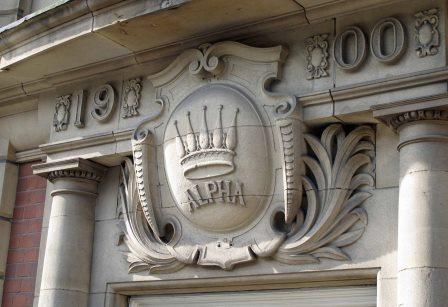
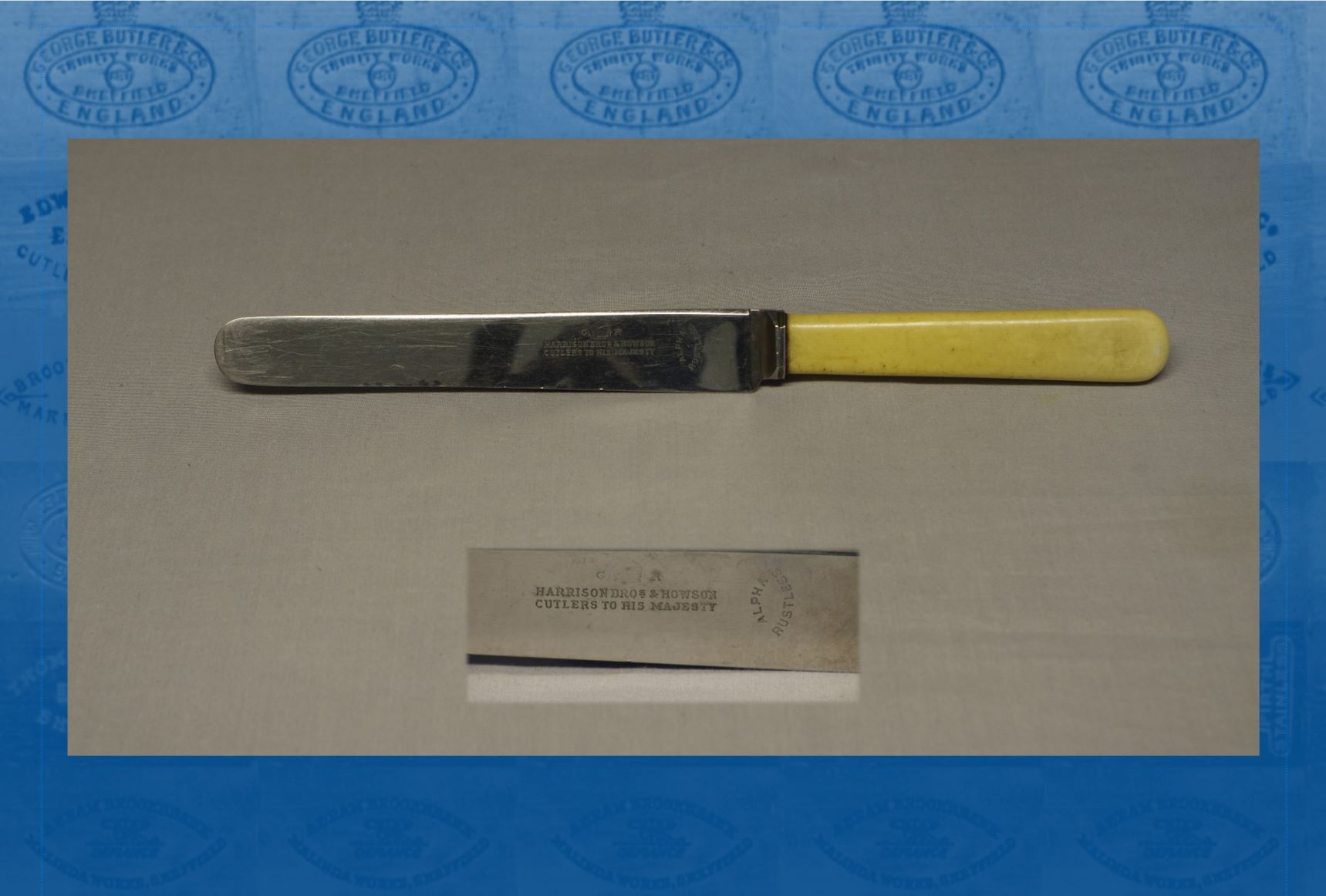
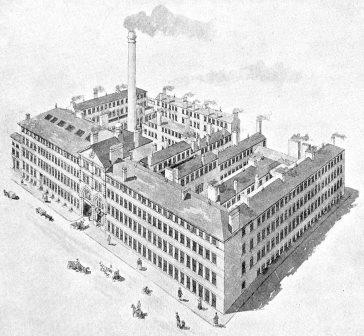
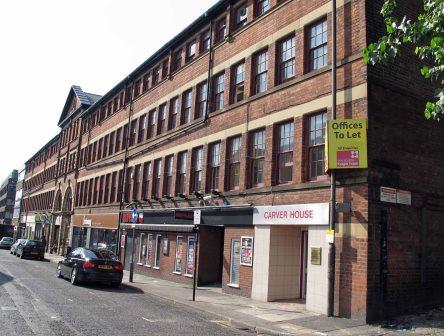
The corporate mark was a coronet with the word ‘ALPHA’, which had apparently been granted to Samuel Harwood in 1836. In 1894, the company purchased the goodwill and ‘Stag’s Head’ trade mark of William Webster. In the following year, Howson registered a silver mark (‘GH’) , in his own name. It was said that Harrison Bros & Howson employed over 700 hands (Men of the Period, 1896). This was an exaggeration, but the Norfolk Street and Shoreham Street workshops were certainly cramped. In 1896, the premises of tool maker Robert Sorby & Sons on Carver Street were acquired. On the site – fronting Carver Street and bounded by West and Division Streets – a new factory was built. It was opened in 1900 and the old manufactories at Norfolk and Shoreham Street were closed. In 1901, the Norfolk Street factory was sold to the retailer Cole Bros for £7,000, but Shoreham Street Works (with frontages to Shoreham Steet, St Mary’s Road, and Margaret Street) had no takers.
The Sheffield Independent, 20 October 1900, in its detailed review of the new premises contrasted them with the ‘shabby, inconvenient, makeshift, sort of premises’ that were the norm in Sheffield. George Howson, too, when interviewed by a local journalist, shortly after moving into the works, painted a rosy picture. Machinery was turning out barrow loads of blank blades and working conditions had been transformed. ‘Half a century ago you did not see’, remarked Howson, ‘a cutler wearing a collar, and it was most unlikely that he had a Sunday suit’ (Callis, 19033). Howson clearly had high hopes for the firm’s mechanized future, but the expected profits did not materialize. He told a government inquiry (House of Commons, Departmental Committee on the Truck Acts, 1908) that: ‘there was not only no profit, but there was a distinct loss on having built that new factory, [and] that if he had employed outworkers and built no workshops he would have been better off than with the factory’.
In 1902, the assets of pocket-knife maker Charles Ibbotson and his ‘SLASH’, ‘EARLY BIRD’, and ‘CHARLO’ trade marks were acquired. Ibbotson, despite having a leg amputated, was retained as a manager. Before 1914, Harrison Bros & Howson was amongst the top half dozen or so cutlery firms in the city, with a workforce perhaps approaching 500. The firm was given a double-page spread in The Sheffield Daily Independent, 24 June 1911. It featured photographs of the factories (old and new) and hand-grinders and silversmiths. It noted approvingly that ‘those who are now at the helm continue to steer the old ship on the same tack’.
In 1913, presses for mass producing seamless articles, such as tea sets and entrée dishes, were installed. However, they were soon turned over to the production of steel helmets for the troops. In 1915, the company became one of the first to experiment with stainless table knives. These were forged from steel supplied by S. E. Howell. But after the War had ended, Harrison Bros & Howson suffered a fate common to other large, family-owned Sheffield firms: stagnation. It still advertised only rarely and its managers stuck to tried-and-trusted ways. International visitors were treated to demonstrations of the old-established methods of grinding, burnishing, and polishing by ‘rows of neat busy girls’. The company assured its audience ‘that no machinery could turn out the same quality as the old hand-worked methods that had been in existence a hundred years ago’ (Sheffield Daily Telegraph, 23 July 1924). Jobs were still handed out to ‘teams’ of workers, with the head of each team having considerable independence to come and go as they pleased and work for other firms (Sheffield Daily Telegraph, 11 January 1928).
The boardroom remained staffed by the family owners, who were increasingly brigadiers and colonels. The firm’s steady decline did not prevent them retiring with a fortune. John Brocksopp Wilkinson died at Tapton Grange on 28 May 1919, leaving £71,476. George Howson was still head of the firm, when he died at Tapton Park on 13 December 1930. He was buried in Fulwood, leaving £37,851. Ownership passed to descendants. These included George Howson’s sons: Brevet-Colonel William Howson (1887-1967) and Brigadier Harold George Howson (1891-1958). John Brocksopp Wilkinson’s sons – Colonel Edgar William Wilkinson (1881-1965) and Frederick Harrison Wilkinson (1883-1946) – also became partners. The latter died at 9 Gladstone Road, Sheffield, on 21 November 1946, leaving £27,784. His brother died at that address on 20 July 1965, leaving £98,140.
The last Howson in the business, Harold George, died on 13 April 1958, aged 66, at his residence North House, Carlton-in-Lindrick, and was buried at St John’s Church, Carlton (Quality, April 1959). He left £22,522. In 1959, the company – which to the last was privately owned – was bought by Viners. The old factory still stands on Carver Street. Above the main entrance, a coronet and the word ‘ALPHA’ is carved in the stone.
1. Jenkins, David E, ‘Keeping It in the Family: A History of Harrison Bros & Howson, Sheffield Cutlers’, Derbyshire Miscellany 14 (Autumn 1996)
2. White, J E, Fourth Report of the Children’s Employment Commission (London, 1865)
3. Callis, Frederick, ‘The Cutlery Trade of Sheffield’, in Harold Cox (ed), British Industries under Free Trade: Essays by Experts (London, 1903)