


Henry C. Booth & Company
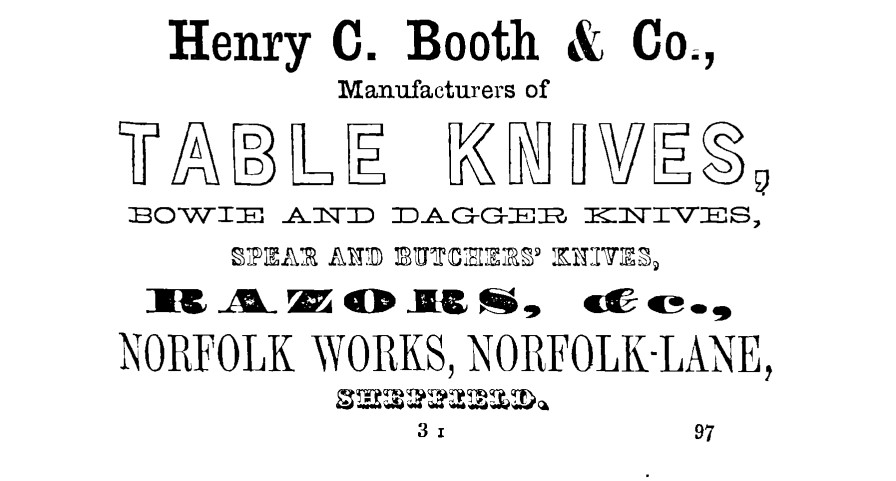
Advertisement from White's 1856 Directory


Henry C. Booth was born on 14 January 1821, the son of George Booth (a scissors smith), and his wife, Keturah. By 1844 – when he married Mary Denholm at St Peter’s Church – Henry was a merchant’s clerk, probably in cutlery. He was at Norfolk Lane in 1851 as a table knife manufacturer (a previous partnership with Samuel Bocking for the manufacture of table knives was dissolved in 1850). According to the Census, Booth employed 20 men and lived in Fitzwilliam Street. He next partnered Robert Carson Murray (d. 1857), an ironfounder at Norfolk Works, Norfolk Lane, until 1853.
In 1856, Booth was listed alone in Norfolk Lane as a manufacturer of table knives, Bowie and dagger knives, and razors. Sheffield directories displayed his advertisements in 1860, 1868, and 1879. In 1861, he employed 31 men, nine boys, and four girls. By the mid-1870s, his address was Norfolk Works, Arundel Street. He traded in ‘table knives and forks, spear point, butchers’, Bowie, and dagger knives, etc., for home and export’. In 1871, he employed 29 workers. His managers included William J. Ward and Benjamin Mitchell. In 1879, Booth had to pay £75 damages and costs for slandering Mitchell as a thief (Sheffield Independent, 2 June 1879).
Henry Booth became wealthy. He moved to Sharrow and by 1881 was living in Rundle Road, where he built an impressive house named Spring Leigh. It was within a short walk of the Kenwood residence of George Wostenholm. He and his wife lived there only briefly. Mary died on 1 November 1882, aged 62. Henry himself died at the same age at Spring Leigh on 27 March 1883. Their grave and monument are in Ecclesall churchyard. Booth left £2,369. Spring Leigh was sold for £5,000, though Booth had further property in Ivy Crescent, Ranmoor, which was still unsold in 1888. The business continued briefly under the Booth name, with W.J. Ward listed as the owner. However, by the end of the nineteenth century, Booth’s had ceased trading. By the late twentieth century, Spring Leigh had fallen derelict and its surrounding gardens (which included a pond) had been covered by modern dwellings.