


George Deakin

Deakin trade mark. Image courtesy of Geoff Tweedale
George Deakin Sen. (bapt.1773-1850) was born at Attercliffe, the son of William (1740-1815) and Mary née Shepperson (1749-1803). William was known as a butcher, but he was also described as a ‘substantial yeoman, farming a considerable piece of land, his own property, in Attercliffe and Tinsley’ (Reid, 18831). He was one of the founders of Zion Chapel at Attercliffe (Vine, 19362). William (and son George) apparently became involved in scissors manufacture with the Barlow family (see Barlows & Deakin). George was apprenticed to scissorsmith Samuel Barlow in 1789 and became a Freeman in 1796 (Leader, 1905-063).
George married Elizabeth Smith, the daughter of a Sheffield bookseller, in 1800. Their sons – William (1803-1829), George (1810-1885), and Robert (1811-1883) – were baptised at Queen Street (Independent) Chapel. After Barlows & Deakin was dissolved in 1812, George Deakin was listed in directories in 1816 and 1818 as a scissors manufacturer at Green Lane. At this location, Deakin had a warehouse (where his teenage clerk was Charles Congreve). He next opened a manufactory at North Street, in the town centre. And he had property, workshops, and a residence at Bacon Island on the River Don, near Kelham (Sheffield Independent, 4 April 1878).
In the early 1820s, Deakin continued to live at the Island, but left Green Lane and concentrated his operations at North Street. Besides making scissors, he also factored saws, shears, sickles, and other types of cutlery. Deakin expanded to Paradise Square, where he became a partner with William Burgon, Thomas Green, and Peter Cadman as a saw manufacturer and factor. This was dissolved in 1830. Simultaneously, he had interests at Norton Hammer Works, with Paul Booth and William Deakin (probably his son) as sickle manufacturers. These ventures led to financial problems. In 1832, Deakin’s freehold estate at Bacon Island was offered for sale. It was described as a ‘most desirable and pleasant Country Residence, being in a very healthy situation, perfectly free from the smoke of the Town …’ (Sheffield Independent, 7 July 1832). Two years later, Deakin filed for bankruptcy. He was ‘out of business’, but ‘late of Arundel Street’, as a scissor manufacturer and general factor (London Gazette, 8 July 1834).
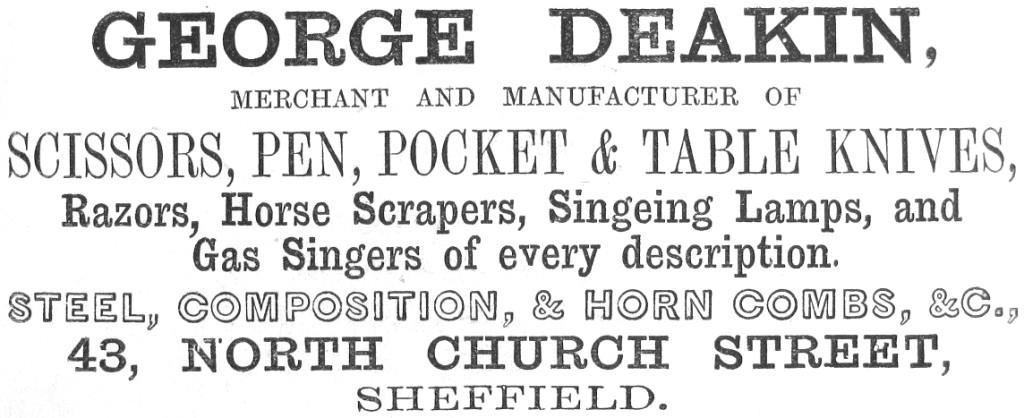
In 1837, George Deakin was listed at Arundel Street as a merchant and table, pen and pocket knife, razor and scissors manufacturer. It is unclear whether this was George Sen. or his son (though it was probably the latter). In the Census (1841), the Deakins were living at the same residence in Arundel Street. George Jun. was a ‘merchant’; his father’s occupation was ‘Independent’ (or living on his own means). In the following year, George Jun. became a Freeman of the Company of Cutlers and was granted his trademark: a picture of a horse’s head. At about this time, Deakin’s began marketing horse singeing lamps, for burning off the long hairs on horses. The ‘lamps’ had a hollow handle for kerosene.
George Deakin Sen. died at Spink House, Bolsterstone, on 1 August 1850, aged 77. His burial was at Attercliffe Cemetery. In the Census (1851), George Jun. and his family (which included his brother, Robert Deakin) were living at 83 Arundel Street (the firm’s works address). George Deakin, ‘inventor and manufacturer’, exhibited at the Crystal Palace in 1851, where he displayed horse-clipping scissors (with composition handles), singeing lamps, and tailors’ shears. He received an Honourable Mention. In the 1850s, George Deakin returned to North Street. By 1864, his works address was Gell Street. In 1868, he was described as a merchant and manufacturer of scissors, pen, pocket, table knives, singeing lamps, and steel combs. By 1879, Deakin was based at Victoria Street. In the Census (1881), he was a retired cutlery merchant. George Deakin, ‘gentleman’, died on 2 April 1885 at Colver Road. He was buried in the General Cemetery, leaving £1,206. Deakin’s name, however, soon reappeared in directories. By 1884, Hale Bros had acquired the ‘horse-head’ mark and continued to use it (alongside a directory listing for Deakin) until the 1950s.
1. T. Wemyss Reid (ed.), A Memoir of John Deakin Heaton of Leeds (London, 1883).
2. G. R. Vine, The Story of Old Attercliffe (Sheffield, 1936).
3. Leader, R E, History of the Company of Cutlers in Hallamshire in the County of York (Sheffield, 1905-6)