


Charles Ibbotson & Company

© Ken Hawley Collection Trust - K.0492


The newspaper obituary of Charles Ibbotson (c.1836-1927) was headlined: ‘Unbeaten by Early Handicaps’ (Sheffield Daily Independent, 14 April 1927). He had been born at Hathersage, the son of Mary Ann Ibbotson (1815-1873). Mary Ann’s father was George Ibbotson, a farmer; her mother was ‘Alathia’. In the Census (1841), Mary Ann was living with four-year-old Charles at the Ibbotson family home at Hathersage. However, no identifiable father was enumerated and Charles may have been illegitimate. In 1844, Mary Ann married first William Kay, a Sheffield tailor. They had a son, John, who became a spring knife cutler. In 1849, Mary Ann became the wife of John Tommason, a cutler. He died in 1851, aged 68, and was buried at St Nicholas’ Church, High Bradfield.
Charles Ibbotson received only a brief education. He lived at Moscar and had to walk each day to the school at Bamford (over three miles distant). After a tramp stole his lunch, his mother decided the walk was too dangerous for an eight-year-old boy and he never attended school again (Sheffield Daily Independent, 14 April 1927). Aged 12, he suffered an injury, which – although considered trivial at the time – led to a permanently disabled leg.
Ibbotson trained as a spring-knife cutler and by 1851 was living and working in Stannington. A speciality of the district was ‘Barlows’ – cheap, but sturdy pocket-knives. When he was interviewed later in life by local journalist Frederick Callis (1903), he recalled: ‘I used to work every day in the week, never taking a holiday or going on the drink, and my wages averaged a guinea (£1.05) a week! I used to make seven dozen Barlow knives a day, and was paid sixpence [2p] a dozen’. He reminisced about how the cutlers would bring their goods down to Sheffield on donkeys from villages like Stannington to sell at the end of each week. In times of high demand (particularly from America), merchants would meet them on the road and bid against each other. ‘If you had met some of the “Mesters” going home you could tell by their appearance how Barlows had gone’.
During the 1860s, Ibbotson moved to Sheffield and joined Thomas Brooks (1839-1893), who had been born at Holloway, Derbyshire. They formed Ibbotson, Brooks & Co, spring knife manufacturers, at Melbourne Works, Suffolk Street. This thoroughfare (which had disappeared by the end of the nineteenth century) was at the end of Meadow Street, near Port Mahon. The district was a hive of tenement factories, slum residences, and beer houses. Melbourne Works was owned (and also occupied) by Isaac Barnes & Sons. In 1869, Barnes auctioned the factory’s working plant, stock-in-trade, and warehouse fixtures (Sheffield Daily Telegraph, 27 April 1869). This seems to have precipitated the dissolution of the Ibbotson and Brooks’ partnership in that year, with the former continuing the business as Charles Ibbotson & Co in Suffolk Street. In 1871, he employed 26 men, seven boys, five women, and three girls (41 hands). In 1869, Charles had married Mary née Holmes. They had a daughter, ‘Aleathea’. The family lived near the factory in Watery Street.
At the end of 1873, Melbourne Works was offered for sale again. Charles Ibbotson & Co relocated to Melbourne Works, 58 Cambridge Street. It was listed as a manufacturer of spring, table, and spear knives. Its best known mark was the word ‘SLASH’, which had been granted to Ibbotson directly. In newspaper advertisements he warned against piracy of his mark and threatened legal action against infringers (Sheffield Daily Telegraph, 18 September 1880). As might be expected from the Works’ name, Ibbotson exported to Australia, where he was said to have an ‘extensive sale of the cheaper class of pocket knives’ (Sheffield Independent, 30 June 1886). He also exported cutlery to America, especially Bowie knives. He was particularly interested in metal-framed handles on Bowie and hunting knives, which were designed to protect delicate handle materials such as pearl. In the early 1880s, he registered several US patents for metal handles. He had already registered these patents in England (B. Levine, Knife World, November 2009).
Ibbotson seems to have been an accomplished manager and his business was described as a remarkably prosperous concern. His factory in Cambridge Street was large enough to house grindstones and a steam boiler for power. In 1891, a 39-year-old spring knife cutler was crushed to death, when he was helping remove a 5-tons engine boiler from its bed. At the subsequent inquest (at which a factory inspector failed to appear) a verdict of ‘accidental death’ was recorded (Sheffield Independent, 26 May 1891).
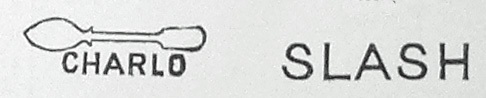
At the end of the 1890s, Ibbotson began to wind down the business. Advertisements offered ‘To Let’ part of his workshops and various light and heavy grinding troughs. In 1902, Ibbotson sold the business to Harrison Bros & Howson, which acquired ‘SLASH’ and other Ibbotson marks, such as ‘EARLY BIRD’ (words and picture). Another Ibbotson mark, apparently for flatware, was a picture of a spoon, above the word ‘CHARLO’ (possibly the former mark of George Charlesworth).
Until he was sixty, Ibbotson’s crippled leg necessitated the use of a metal stand. But when he reached 68, he decided to have the leg amputated. Even then, he stayed on as a manager at Harrison Bros & Howson. He did not retire until he was 86, when his eyesight was failing. Charles Ibbotson, Machon Bank, died on 14 April 1927, aged 91. At his funeral, he had requested no mourning and no display, so the graveside service at the General Cemetery took only two minutes. He left £4,062.