


Gladwin Ltd
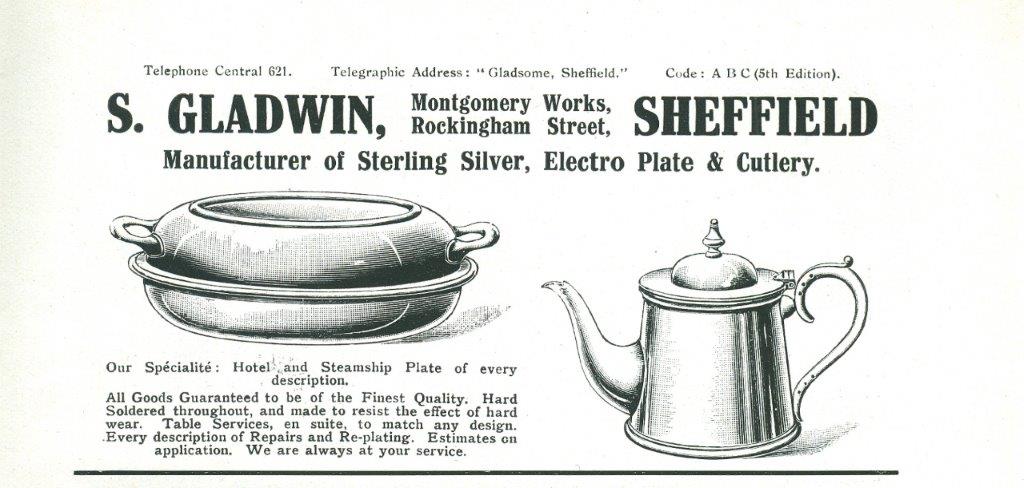
Advertisement from 1919


Sam Gladwin was born in Sheffield in 1884, the son of John Henry (a collector for sewing machines) and his wife, Theresa. Sam’s father died in 1893, aged 33, and was buried at Wardsend Cemetery. He was raised by his mother in straitened circumstances, but he found work as a silversmith (training as a saw piercer). In about 1903, Sam apparently began working for himself. In 1912, he appeared in a directory as a Britannia metal ware manufacturer in Eyre Street. He married in 1913. By the First World War, he was a silversmith at Montgomery Works, Rockingham Street. In 1922, Gladwin’s became a private limited company at Embassy Works, Rockingham Street. The nominal capital was £35,000 in £1 shares, of which 10,000 were issued as preference shares. Gladwin was managing director and chairman; his manager was Joseph E. Percharde (Sheffield Independent, 15 July 1922).
Gladwin and Percharde apparently pursued the cutlery and electro-plate trade with vigour, which enabled the firm to survive the difficult interwar years. Its biggest orders were from the Dominions, catering organisations (such as Lyons), and the shipping companies (such as Cunard). Gladwin had a taste for travel and publicity. He set sail on a world tour, organised by various Chambers of Commerce. The Sheffield Independent, 8 May 1923, enthused:
When the British trade ship sails on its world tour to ‘push’ British goods in Empire and foreign markets it will have a small Sheffield boy mascot, and by the time the voyage completed he will be the best travelled boy in the world. He is Clifford Gladwin, the four-and-a half-year-old son of Mr S. Gladwin ... In company with his father and mother, he is going on the British Trade ship on a 41,000 mile tour of the world to sell goods and get orders for more. Mr. Gladwin … is one of the few Sheffield men who are going on this unique commercial expedition. He is … a keen advocate of modern scientific factory organisation as against the old rule of thumb methods (Sheffield Independent, 8 May 1923).
According to one press report: ‘staff have been increased and machinery is never at a standstill from early morning until late at night. Spoons and forks are one of their big specialities’. Percharde added: ‘we do not wait for orders to come in – we go and seek them’ (Sheffield Independent, 10 November 1923). In the following year, Sam Gladwin made a bid for the ailing Martin, Hall. The takeover was achieved by an exchange of preference shares (nominally valued at £41,250) for Martin, Hall’s share capital (valued at £125,000). Joseph E. Percharde was appointed a co-director of Martin, Hall, alongside Frank A. Martin.
Gladwin’s plans for Martin, Hall are difficult to divine. It has been suggested that it was an asset-stripping exercise. Certainly, Gladwin’s involvement was brief. In 1926, as trading conditions at Martin, Hall worsened, Sam Gladwin relinquished control of that company and offloaded his block of preference shares to a local industrialist, R. Edwin Eddison. At the start of 1927, it was suddenly announced that Percharde was leaving to join A. E. Furniss & Sons. Gladwin, however, retained the services of Philip A. Wake (1853-1933) as chairman. Wake had been chairman of Martin, Hall. This ageing solicitor was a useful figurehead at Gladwin’s annual meetings.
Gladwin’s struggled during the Slump, but continued to win orders to equip ocean liners with cutlery, spoons and teapots. One order in 1935, for example, was for the Queen Mary. Sam Gladwin, chairman and managing director, of Sale Hill, died (aged 61) on 18 January 1946. The funeral was at City Road crematorium. He left £17,248. His son, Clifford, had been killed in action in 1944, but his wife, Grace Craig Gladwin, remained a director. She lived at Stumperlowe Mansions and died at 401 Sandygate Road on 15 April 1957. She was aged 66 and left £60,679. Frank A. Martin was a director and secretary of Gladwin until his death on 31 May 1952. Two hundred employees apparently attended his funeral at Ecclesall.
In 1959, Gladwin was acquired by Mappin & Webb at Royal Works, Queen’s Road. Gladwin thence became part of British Silverware Ltd, which had collapsed by 1971. Gladwin’s trade marks included ‘EMBASSY’, ‘AMBASSADOR’, and ‘BRIMET’.