


Daniel & George Holy
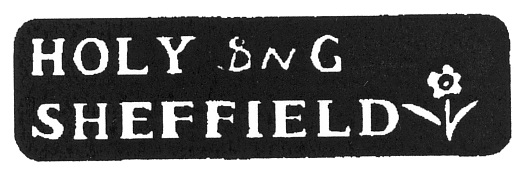
Trade Mark. Image courtesy of Geoff Tweedale
Daniel Holy (1754-1831) was a descendant of a prosperous family involved in the eighteenth-century button trade (Smith, 19971). He was baptised at Upper Chapel, the son of Thomas Holy (c.1720-c.1760) and his wife Sarah née Wilson (1725-1768). His older brother, Thomas Holy (1752-1830), was a merchant and a prominent Methodist (see Holy, Newbould & Suckley). His mother, Sarah, was a descendant of the snuff-making Wilsons of Sharrow and related to James Vickers another Methodist. The Holy family owned land in the Crookes district, which led locals to name the area Mount Pisgah – a reference to Moses viewing the Promised Land from the Mount, since all the land that could be seen to the east of the hill was owned by the Holy family.
Daniel Holy succeeded as a teenager to workshops in Mulberry Street (at the corner with Norfolk Street) and registered silver marks as a plate worker in 1776 and 1778. He partnered first George Woodhead, a merchant, who may have later been involved in Greaves, Woodhead & Hodgson. Partnership changes (as with several silverplate firms) then became increasingly complex and are difficult to track (Bradbury, 19122; Law, 20003). After 1783, Holy was joined by Robert Robinson and Robert Frederick Wilkinson, which led in 1784 to the registration of a tobacco pipe mark for silver wares on behalf of Daniel Holy, Wilkinson & Co. Other partners involved at various times included Samuel Wainwright and Joseph Drabble. Crosskey (2011)4 shows that the partners invested £7,500 in the business as follows: Holy £2,400, Woodhead and Wilkinson £1,800 each, Drabble £1,200, and Robinson £300.
In 1803, Drabble, Wilkinson, and Robinson left and launched their own silverplate firm (see Wilkinson, Drabble, Mylius & Co). Daniel Holy & Co continued with new partners: Ebenezer Parker, William Creswell Webb, William Hall, and William Hadfield (c.1776-1826). It seems that Ebenezer Parker was the son of former Master Cutler, William Parker. Hall was a ‘pierce worker’; Webb was a Birmingham bookkeeper; and Hadfield was a die sinker. As Daniel Holy, Parker & Co, the partners registered a pineapple mark in 1804 (Assay Office, 19085). Webb withdrew in 1808; Parker died in 1812. In 1812, Daniel’s son, George, entered the firm and it became Daniel & George Holy & Co. A nephew of the late Ebenezer Parker (also named Ebenezer) had an interest in the firm.
In 1822, D. & G. Holy registered a silver mark at Mulberry Street. During the 1820s, products included silver-plate, table and pocket knives, and razors. William Hadfield died on 1 August 1826, aged 50, ‘a man of the utmost integrity’. His death was ‘very sudden – finding himself unwell, he was returning home and fell down in Allen Street, and expired immediately’ (Sheffield Independent, 5 August 1826). Daniel Holy lived in New Church Street. He died on 29 May 1831, aged 77. Another partner was William Hall, a silverplater. He died on 25 January 1833, aged 60, and was buried at St Paul’s churchyard on the same day. He and Sarah had a son – William (1811-1868) – and a daughter, Catherine (1805-1862), who married into the Colley family (see Colley & Co).
A depression hit the silver-plate trade and so the firm – now led by Daniel Holy (George’s son) – closed the silver manufactory in Mulberry Street (Sheffield Independent, 19 January 1833). Instead, Holy’s began selling steel, saws, and edge tools from Norfolk Lane. Between about 1837 and 1852, Daniel & George Holy was based in Eyre Lane as a merchant / manufacturer of table and pocket knives, razors, saws, files, edge tools, and steel. In 1852, D. & G. Holy was dissolved. George Holy died on 16 April 1859, aged 72. Daniel Holy retired to Burnt Stones, Sandygate. He died on 31 December 1870, aged 70. Their sister, Mrs Caroline Davenport, died on 24 April 1875, aged 70. Their grave monument is at Fulwood. Daniel willed that, after the death of Caroline, the bulk of his estate should be bequeathed to Sheffield charities. The most notable was the Sheffield School for Blind Children, which was built in Manchester Road in 1879, with Holy’s contribution over £20,000.
1 Smith, D J, The Cutlery Industry in the Stannington Area (Sheffield, 1977)
2 Bradbury, F, History of Old Sheffield Plate (London, 1912)
3 Law, Edward J., ‘The Origins of the Silver Trade in Sheffield’ (2000). Posted at: http://homepage.eircom.net/~lawed/index.htm
4 Crosskey, Gordon, Old Sheffield Plate: A History of the 18th Century Plated Trade (Sheffield, 2011)
5 Sheffield Assay Office, Old Silver Platers and Their Marks (1908)