


Francis Howard Ltd
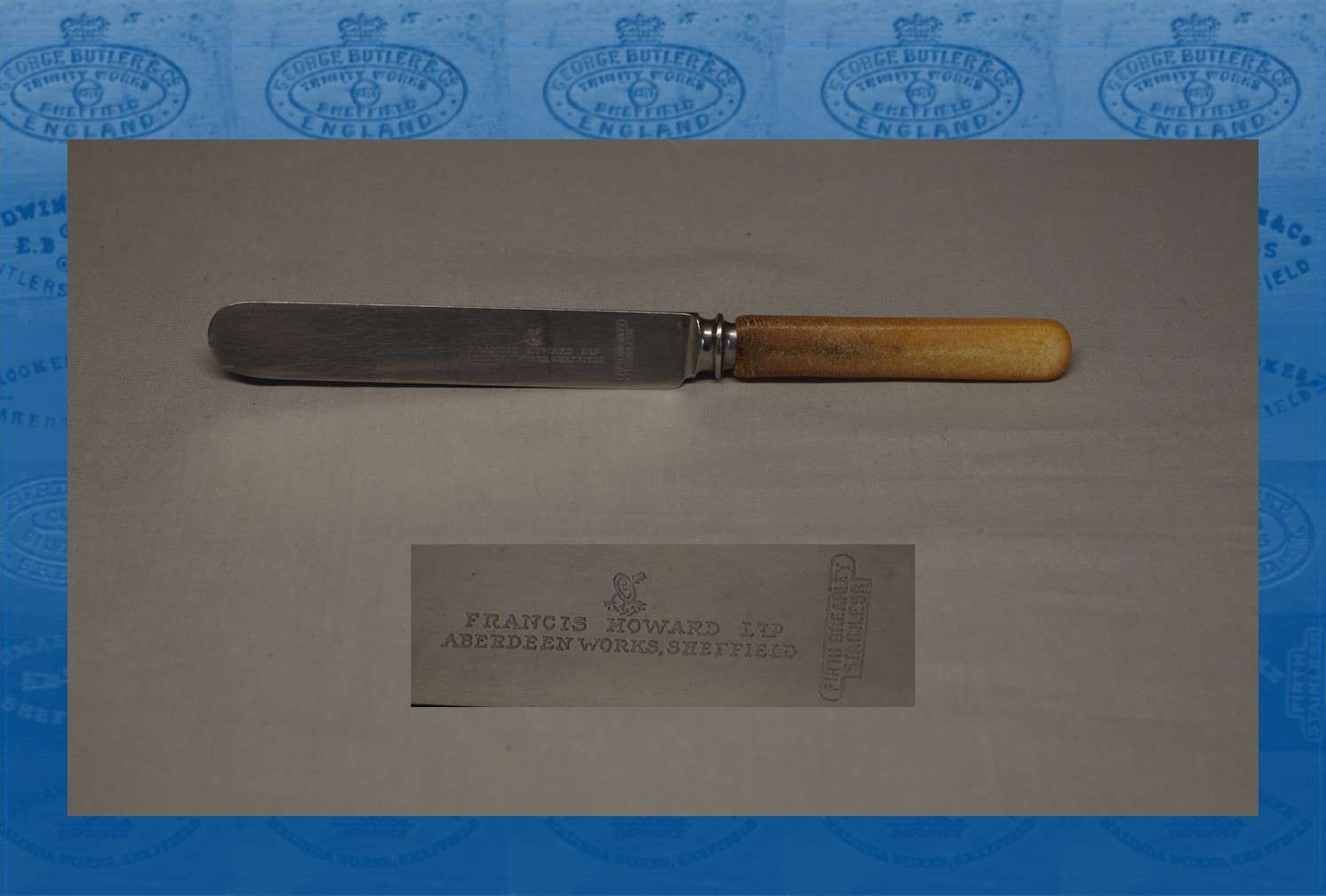
© Ken Hawley Collection Trust - K.0681
Francis Howard (c.1837-1905) was born in Ireland. By 1861, he was living in Sheffield in Craven Street and working as a merchant’s clerk. His wife, Frances née Oliver, was a file cutter. Howard began specialising in electro-plated cutlery. Between 1866 and 1870, he was a partner in William Batt & Sons. In 1870, Howard began working on his own account at West End Works, West Street, where he employed three men, three women, and two boys. The Howards had a son, Francis Oliver Howard (1872-1908). However, Frances died in 1877, aged 39. In the following year, Howard married at Christ Church, Fulwood, Martha née Hawksworth (1846-1886), the daughter of a Britannia metal smith. Their son was John Wilfred Hawksworth Howard (1880-1970).
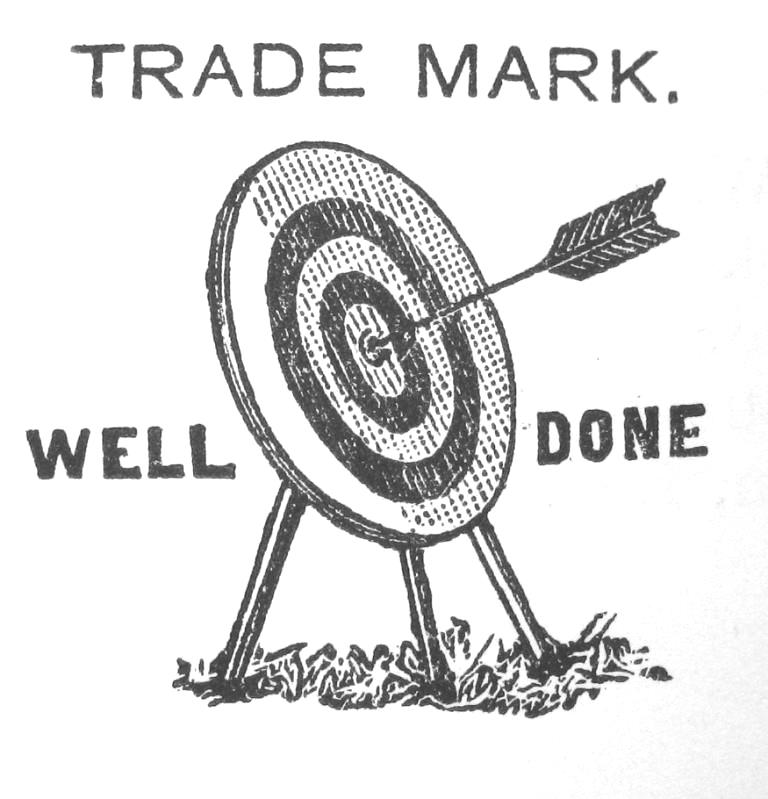
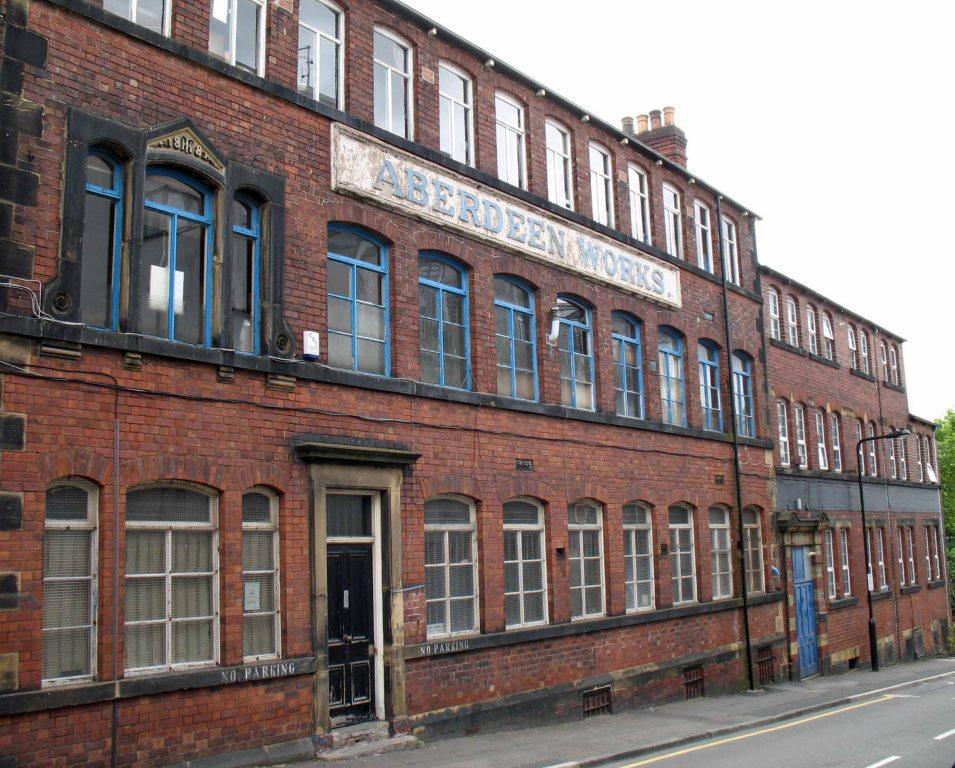
Francis Howard registered a silver mark in 1878. In 1881, he employed fourteen workers. He moved to Aberdeen Works, a custom-built factory, in 1883. It seems that the building originally had two storeys, with a third range added later. Additional workshops were also acquired at adjacent 99 Division Street, which for many years were occupied by Edwin Marsden, an ivory cutter, with whom Howard had a connection. Scotland was Howard’s favourite market and he did most of the travelling in that region. He sold plated fish servers and eaters, dessert and butter knives, besides spoons and forks. The trade mark was ‘WELL DONE’, depicting a target pierced in the bullseye by an arrow. Further silver marks were registered in 1894 and 1901. Francis Howard lived at Storth Road, Nether Green, and was well known in the district. He was a member of the Ecclesall Board of Guardians, a Conservative, and attended Ranmoor Church. After a period of illness, he died at Windsor Crescent, Bridlington, on 17 June 1905, aged 68 (Sheffield Daily Telegraph, 19, 20 June). His burial was at Christ Church, Fulwood (where he had once been a warden). His estate was valued at £13,776 (net personalty £7,893). He left a widow, Emily Theresa née Simpson (1853-1925), eighteen years his junior, whom he had married in 1890.
Francis Howard’s eldest son, Francis Oliver, had been a traveller – presumably for the firm. However, after an unhappy marriage (he divorced his wife in 1899), he died at Ecclesall workhouse on 13 April 1908, aged 35, leaving £384. His burial was at Ecclesall. John W. H. Howard (a ‘forwarding clerk’ in 1901) operated the firm after his father’s death. By 1918, John had a partner – Addy Clapham (1869-1956) – who was likely the firm’s manager and traveller. In 1921, Francis Howard was registered as private limited company, with £20,000 capital. The firm absorbed the Howard-Clapham partnership. It also took over a small silversmith, Barclay & Co, which was owned by Ellen Jane Watts (1880-?). Barclay’s was listed as a manufacturing silversmiths at 84 Charles Street in 1922, when it was styled as ‘James Barclay’. In 1925, Miss Ellen J. Watts was listed as a silversmith at the Charles Street address.
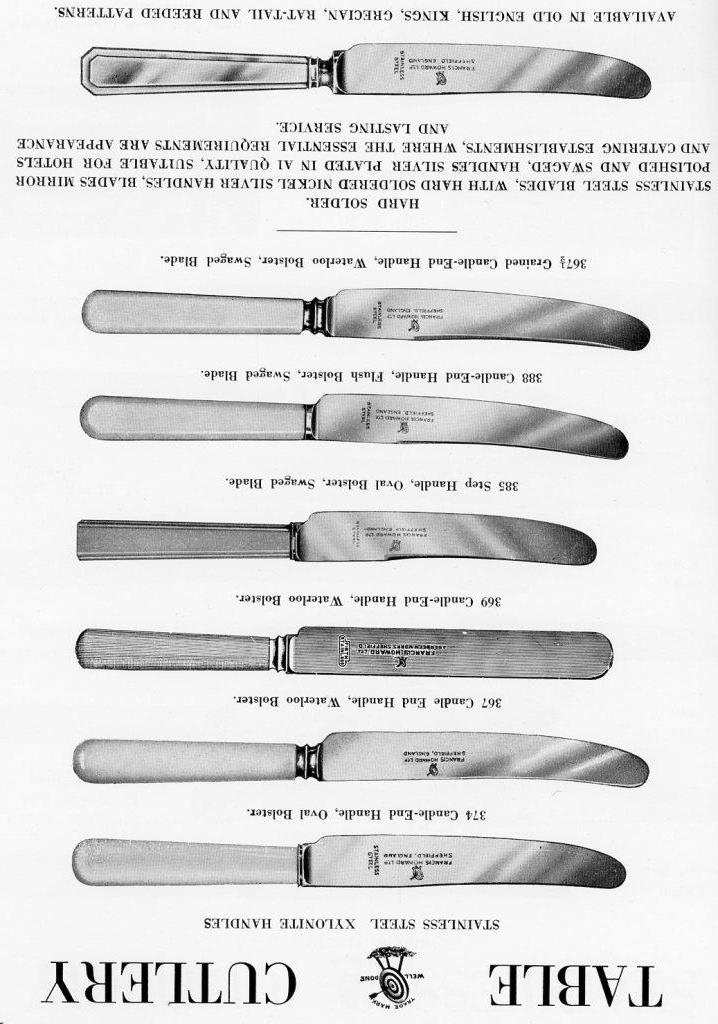
The first directors of Francis Howard Ltd were J. W. H. Howard and Francis Thomas Clark, a commercial traveller. Addy Clapham remained a partner. He later moved to Hambledon, Surrey, and still described himself as a silver and cutlery manufacturer in 1939. In the twentieth century, the Howard business continued to be family-owned and seems to have always been prosperous. The descendants were J. W. H. Howard’s son, John Hawksworth Howard (1911-1982), and his wife, Kathleen Francis née Slater (1914-1993); followed by John and Kathleen’s son, John Francis Hawksworth Howard (1942-2020). In about 1960, the Howards acquired H. Hunt, which had been owned by Harold Hunt (1878-1962), an electro-plate manufacturer at Backfields. Catalogues featured the marks of both companies: ‘FH’ and ‘HH’. In the 1960s, Howard’s products included: ‘Firth Stainless’ table knives and EPNS tableware (spoons, forks, fish eaters); stag-handled steak knives and forks; boxed sets and canteens of cutlery; pocket knives; tea sets and hotel ware; condiment sets; and reproductions of wares in old Sheffield Plate. The firm’s output was usually sold to the trade, with catering establishments and hotels as the main customers. Under the fifth-generation owner, Andrew Francis Howard, the firm has continued to market sterling silver tableware and giftware. Aberdeen Works still stands in Trafalgar Street and is Grade II listed.